The right choice depends on the complete work cycle, not the stacker’s headline capacity. By measuring moves, travel, lift height, pallet condition, aisle clearance, floor quality and battery demand, you can decide whether automation will improve repetitive work or create new constraints.
Key takeaways
- Measure pallet weight, dimensions and lift height before comparing stacker capacity.
- Choose automation when repeated routes and lifting justify reduced manual control.
- Check aisle width, floor condition, traffic and emergency recovery access.
- Run a measured duty-cycle trial across the busiest expected shift.
What “automatic” means—and when the workload justifies it
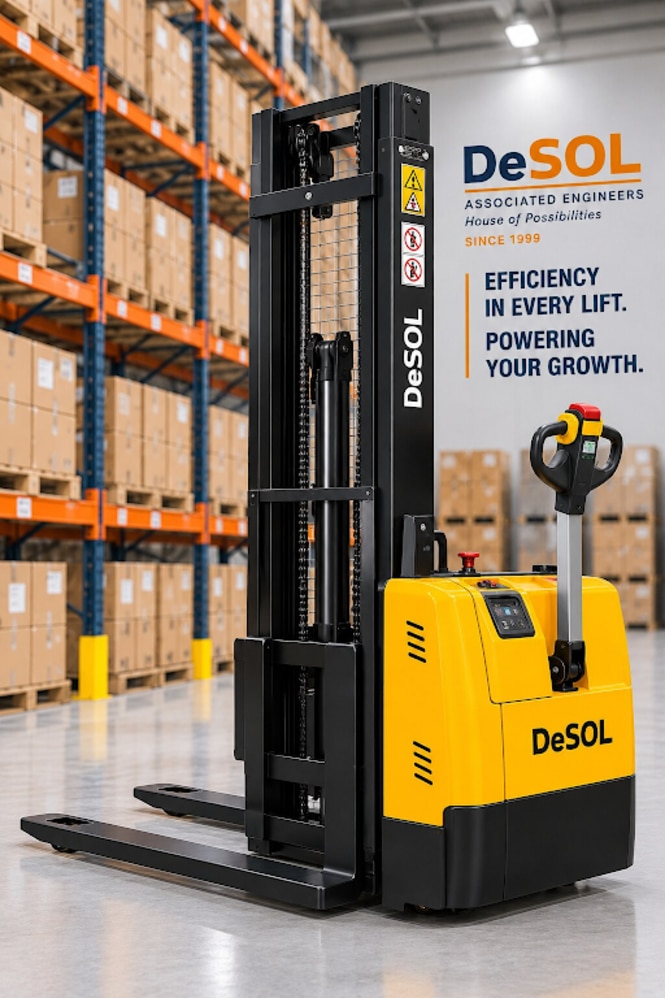
An automatic electric stacker powers lifting, lowering, travel and steering controls, then follows a programmed route or command without continuous manual pushing or steering. The operator still selects the job, confirms pallet position, supervises people and obstacles, and intervenes during faults, blocked routes, emergency stops or manual recovery.
| Option | Main operator effort | Best workload fit |
|---|---|---|
| Manual stacker | Push, steer, lift and lower by hand | Occasional lifts over short distances |
| Semi-electric stacker | Powered lifting; manual travel and steering | Regular lifting with limited travel |
| Automatic electric stacker | Powered lifting, powered lowering, travel and steering | Repetitive, defined routes and frequent stacking |
Choose an automatic model when the same pallet movement repeats through much of the shift, especially between fixed pickup and drop-off points.
A useful threshold is when an operator performs roughly 15 to 20 or more comparable moves per hour, works two or more shifts, or walks several kilometres per shift; measure your actual figures rather than relying on the label “frequent.”
Automation earns its cost through reduced walking, less steering effort and steadier cycle times. It is less suitable when loads, destinations or traffic change constantly. A rider truck, conveyor interface or automated storage-and-retrieval system will usually handle high-throughput work better when several moves occur simultaneously or travel routes are long.
Before approval, verify:
- The automatic route, stopping distance and pedestrian controls
- Manual override and recovery after a blocked route
- Battery endurance across the complete shift
- Floor joints, ramps, contamination and aisle clearance
Measure the load, lift and pallet before comparing capacity
Start with the heaviest pallet at the highest storage position, not the stacker’s headline capacity. Record the loaded and unloaded travel distance, pallet moves per hour, lift count per shift, and operating hours; frequent work exposes weaknesses that an occasional lift will not.
Measure each part of the application before reading the capacity plate:
| Measure | Record | Why it matters |
|---|---|---|
| Load | Actual weight, dimensions, overhang and weight distribution | The rated capacity applies only at a stated load centre and configuration. |
| Load centre | Horizontal distance from the fork face to the load’s centre of gravity | A longer load centre reduces allowable capacity and can make the load unstable. |
| Lift | Required fork height, rack beam height, top clearance and maximum lift height specifications | Capacity usually falls as the mast rises; compare residual capacity at the actual height. |
| Pallet | Overall length and width, entry openings, bottom-board layout and damage | A broken board or unsupported pallet can shift during lifting. |
| Forks | Length, width, thickness, spacing and adjustment range | Forks must enter far enough without striking the pallet or leaving excessive overhang. |
Ask for the manufacturer’s residual capacity at your exact load centre and lift height, shown on the truck’s capacity plate. Do not substitute the rated capacity for that figure.
- Weigh the heaviest pallet, including packaging and attachments.
- Check both forks support the pallet load evenly.
- Compare the complete lift-and-travel cycle at the actual rack level, because higher lifts add mast time and demand slower, more precise positioning.
Check aisles, floors, traffic and the limits of automation
A truck that fits between rack uprights can still be unsuitable for automatic travel. Check aisle width together with turning clearance, fork clearance, pallet overhang, rack protection, sensor stopping distance and space for pedestrians; physical entry alone does not prove reliable operation.
Floor condition is a go-or-no-go factor. Potholes, abrupt level changes, expansion joints, slippery contamination and inadequate load-bearing capacity can cause wheel slip, pallet instability, navigation errors or emergency stops. Survey the route against the truck’s wheel, mast and sensor requirements, not a generic warehouse specification.
Use the following checks before selecting the route:
- Reject routes where cross-aisles, dock doors, charging points or pallet drop zones mix pedestrians and vehicles without physical segregation, controlled crossings, visibility measures and right-of-way rules. An audible alarm is not traffic control.
- Standardise pallet dimensions, fork-entry openings, load distribution and overhang. Closed-bottom pallets can block fork entry, while wrapped loads can hide the opening.
- Remove damaged pallets from automatic service. Broken boards, loose components and leaning loads can cause failed pickup or unsafe placement.
- Confirm that destinations remain repeatable and clearly defined. Constantly changing drop points or judgment-based placement weakens the case for automation.
- Test recovery from blocked routes, sensor contamination, lost localisation, battery depletion and emergency-stop reset. If manual operation is available, assess and document that mode separately.
If the route depends on an operator improvising around obstacles or correcting inconsistent pallets, choose a controlled process before choosing the truck.
Match battery capacity to repetitive lifting and shift demand
Size the battery for the actual duty cycle, not the advertised lift capacity. Record pallet moves per hour, travel distance, loaded and unloaded travel, lift height, and operating hours; repeated mast lifting can consume as much operating energy as traction, especially at high rack levels.
Measure these demands before accepting a shift rating:
- Count peak pallet moves per hour, not just the daily average.
- Include acceleration, congestion, cold-room operation, and long empty returns.
- Time complete cycles at the highest rack level, including positioning and lowering.
- Calculate whether one shift, two shifts, or continuous operation leaves time for charging.
Battery type changes the charging plan:
| Battery system | Operating constraint | Charging implication |
|---|---|---|
| Lead-acid | Needs cooling, electrolyte maintenance, and ventilation | Schedule lead-acid battery charging during breaks or shifts; provide a designated area with spill-flushing facilities, fire protection, secured batteries, and controlled ignition sources. |
| Lithium-ion | Supports frequent partial charging but depends on battery-management and temperature controls | Use lithium-ion opportunity charging only with the supplier-approved charger, battery, and connection procedure. |
A nameplate runtime is not transferable between applications. Ask for measured or simulated battery runtime under your load weight, lift height, travel route, and shift pattern, then define a backup battery or charging point before purchase.
If the stacker cannot complete the planned cycle without an unplanned stoppage, it is unsuitable for frequent work. Long routes, high lifts, or multi-shift throughput can justify a rider truck, reach truck, or conveyor interface instead.
Use a measured duty-cycle trial before you commit
Approve the stacker only after the supplier runs a measured duty-cycle assessment using your actual pallets, route and shift pattern. A headline lift rating does not prove that the truck can repeat the work without overheating, losing battery capacity or exceeding its specified cycle limit.
1. Ask for a cycle-time trial covering pallet moves per hour, loaded and unloaded travel, travel distance, lift height, load weight and operating hours. Record completed moves, queue time, charging interruptions and stopping distance rather than accepting a simulated average.
2. Require the supplier to state the maximum cycles, residual capacity at your lift height and expected battery runtime for that duty pattern. Request an energy profile that includes traction and mast lifting, not just a nameplate shift rating.
3. Agree a charging strategy before approval. For lead-acid, identify charging space, cooling time and battery changes; for lithium-ion, verify charger compatibility, battery-management controls and temperature limits.
4. Test automatic operation and the manual override separately. Make the supplier demonstrate recovery after a blocked route, emergency-stop reset, depleted battery, dirty sensor and lost localization, with a written procedure for each state.
5. Request the safety file showing how the application addresses people detection, speed control, traffic management and stopping distances under ISO 3691-4. Desol Associated Engineers can use the same trial record to compare whether an automatic, semi-electric or manual model fits the measured workload.
Reject approval if the trial depends on an operator improvising recovery or if the supplier cannot produce repeatable results across the planned shift.
Related product
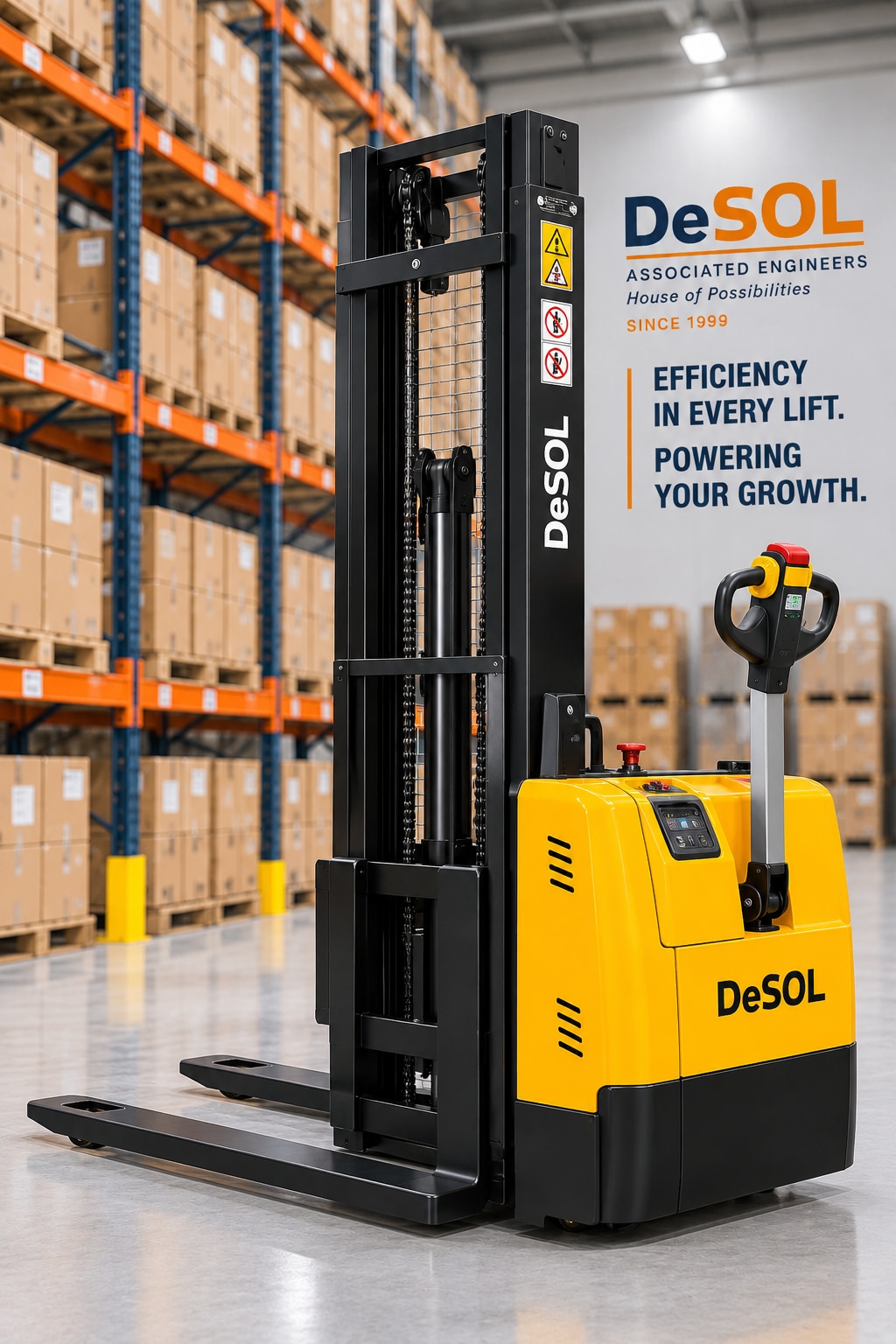 | Material Handling Equipment / Electric Stacker DeSOL Automatic Electric Stackers are designed for efficient, reliable and safe lifting and movement of palletized materials in warehouses,... View product → |
Frequently asked questions
When does an automatic electric stacker justify its cost?
It suits frequent, repeatable pallet lifting and stacking where programmed travel and powered controls reduce repeated manual handling. Confirm the workload through a measured duty-cycle trial.
What should you measure before choosing a stacker?
Record the heaviest pallet, load-centre distance, pallet dimensions, required lift height, rack clearances and turning space. Compare these figures with the stacker's rated capacity and dimensions.
What site conditions can limit an automatic electric stacker?
Check aisle width, floor levelness, surface damage, ramps, pedestrian traffic, crossing points, rack clearances and emergency access. Automation does not remove the need for obstacle detection and manual recovery.
How do you match battery capacity to the workload?
Estimate lifting, lowering, travel, steering, pauses and charging time across each shift. Compare the required duty cycle with usable battery capacity and the available charging window.