A hydraulic goods lift is not selected safely from a capacity figure and a product photograph. You need to match its legal category, load geometry, duty cycle, building interface, safeguarding and maintenance access to the way your site actually operates. By the end, you will have a supplier checklist that separates a suitable multilevel installation from a generic hydraulic-lift quotation.
Key takeaways
- Demand the declared equipment category and a copy of every applicable licence.
- Require rated load, platform dimensions, travel height and duty cycle in the quotation.
- Check shaft clearances, door locations, traffic routes and pallet-handling method before ordering.
- Insist on overspeed protection, hose-burst control, emergency lowering and documented testing.
Which legal category and compliance evidence apply to the lift?
Start with the declared equipment category, not the word “hydraulic.” The quotation must state why the proposed machine is a lifting table, service lift, industrial lift, or machinery-integrated lifting device under the rules applying at your site. This is the first check against vague hydraulic lift regulations claims.
| Category | What identifies it | Evidence to request |
|---|---|---|
| Lifting table | Up to two fixed landings; rated speed within EN 1570-1 limits, including 0.15 m/s | EN 1570-1 conformity basis, rated-load data, drawings and risk assessment |
| Multi-landing goods lift | More than two fixed landings or a dedicated vertical goods route | Applicable multi-landing standard or national rules, landing-door design evidence and examination instructions |
| Industrial lift | Goods-only workplace equipment with controlled access | Industrial lift classification, guarding and interlock evidence, installation risk assessment |
| Machinery-integrated device | Permanently connected to a production line, conveyor or automated system | Integration risk assessment, control-system responsibilities and complete machinery technical file |
Ask the supplier to identify the exact clause, standard and legal route used, rather than supplying a generic declaration. A CE mark or ISO 9001 certificate alone does not prove equipment-specific safety.
Require service lift compliance documentation before ordering. It should include the declaration of conformity or incorporation, technical file index, load and speed ratings, layout drawings, door-interlock details, emergency-lowering procedure, inspection schedule and maintenance responsibilities.
If the workplace falls under UK LOLER, obtain the written examination scheme and confirm whether the goods-only lift is examined as lifting equipment, not under a people-lifting assumption.
What capacity, geometry and duty-cycle data must the quotation state?
The quotation must prove the lift’s rated load for your complete operating pattern, not just the weight of the heaviest item. State the combined mass of goods, pallet, cage, stillage, pallet truck and operator exclusion or inclusion, then request platform dimensions, lifting height, lowered height, usable travel, lifting speed and maximum platform deflection.
Ask for allowable point loads, wheel loads and eccentricity limits. A 2,000 kg rating does not prove safe entry by a 2,000 kg pallet truck from one side.
Request these duty figures:
- Maximum load, load distribution and centre-of-load position
- Starts per hour, lifts per hour, cycles per day and dwell time at each landing
- Whether loads are palletized, wheeled, rolling, impact-loaded or placed by forklift
- Ambient temperature and any dust, moisture or corrosive exposure
- The required travel height and loading frequency at every landing
| Loading case | What the quotation must state | What it prevents |
|---|---|---|
| Centered pallet | Total mass, centre position and pallet dimensions | Selecting from product weight alone |
| Pallet-truck entry | Wheel loads, axle spacing, entry direction and impact allowance | Platform damage from concentrated rolling loads |
| Offset or uneven load | Permitted eccentricity, point loads and deflection | Tilting, binding or guide overload |
| Repeated warehouse service | Starts per hour, cycles per day, speed and duty rating | Overheating a low-cycle lift |
For a table serving up to two fixed landings, check whether EN 1570-1 applies, including its 0.15 m/s rated-speed boundary. More than two fixed landings require applicable multi-landing requirements. Freeze pit, headroom and shaft dimensions only after receiving certified guide, mast, cylinder, anchor and sill reactions; slab thickness alone proves nothing.
Will the lift fit the building, traffic route and load-handling method?
Do not freeze the pit depth, shaft size or landing details until the supplier issues certified loads and reactions. Check floor loading against slab capacity, then verify overhead clearance, door openings, landing sill levels, loading sides, aisle width and forklift approach clearance.
A nominal pit dimension does not prove that the building can carry guide-rail, mast, cylinder, anchor and sill loads.
Ask the site team to record:
- Floor loading at the lift base and each landing
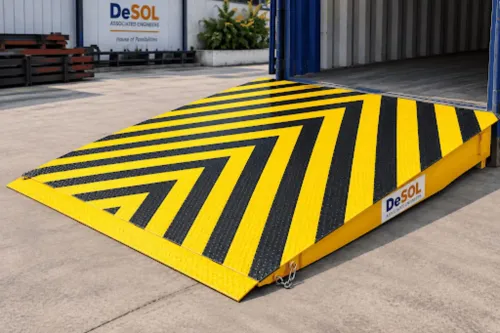
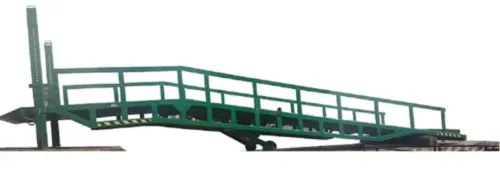
- Pit depth, or ramp geometry if a pit is impossible
- Overhead clearance above the fully raised platform
- Shaft or guarding dimensions, including maintenance access
- Pallet, cage or stillage dimensions and the direction of entry
- Turning space for pallet trucks and forklifts
Choose the configuration against the route and handling method:
| Option | Best fit | Main limitation |
|---|---|---|
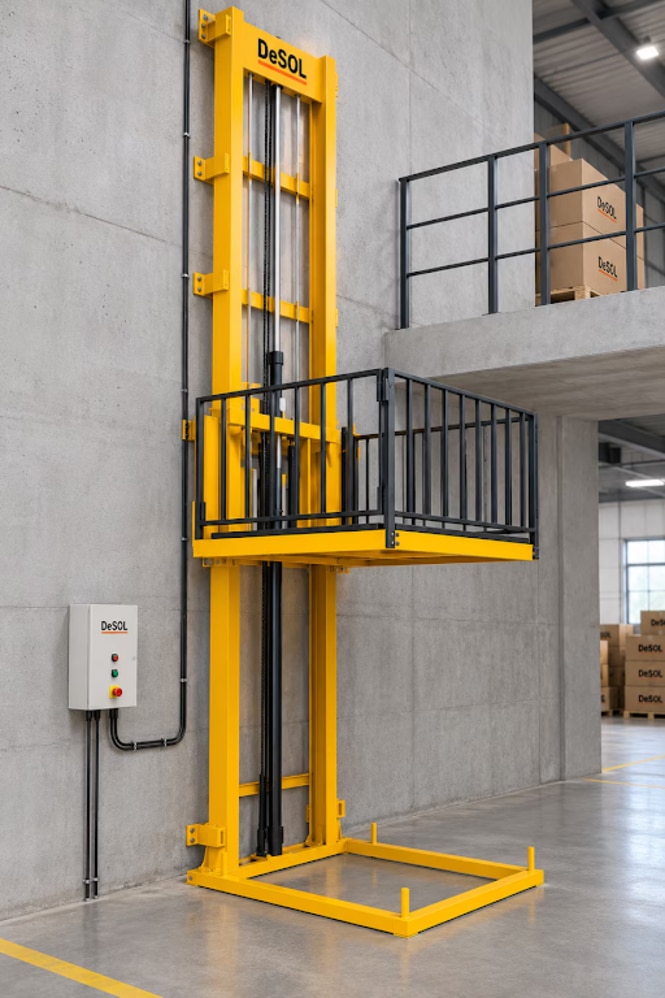
| Single-mast goods lift | Light-to-moderate loads with clear side loading | Greater sensitivity to eccentric loading |
| Twin-mast goods lift | Wider platforms, heavier or uneven loads | Needs more structure and installation space |
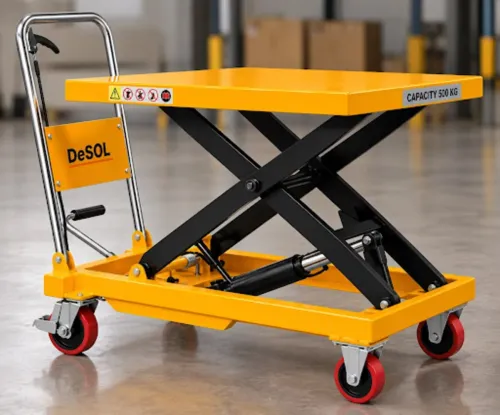
| Scissor lift | Short travel between nearby levels, surface-mounted access | Requires guarding and a suitable ramp or pit arrangement |
| Enclosed lift | Frequent traffic, multiple landings, controlled access | Larger shaft and landing-interface demands |
| Lift table | Vertical positioning within one work area | Not a substitute for multilevel transport |
| Forklift or hoist | Flexible handling where operators and clear routes exist | Needs trained operation and leaves route conflicts |
| Conveyor | Repeated, fixed-direction pallet flow | Poor choice for variable destinations |
A single-mast goods lift is unsuitable when pallet-truck entry creates large offset or wheel loads unless the supplier confirms those loads in writing. Reserve a passenger or goods-passenger lift for people-rated duty; a goods-only installation is not an automatic substitute.
Which safeguards and hydraulic failure controls should you demand?
Demand a documented fall-prevention and access-control design, not just a pump-pressure rating. A goods-only lift must prevent people from riding, entering the shaft, opening a landing while the platform is moving, or reaching a crushing point during loading.
| Safeguard | Failure or hazard controlled | Evidence to request |
|---|---|---|
| Mechanically secured gates and interlocked landing doors | Entry at an unsecured level and platform movement with a gate open | Door-lock ratings, wiring diagram and failed-interlock test |
| Hose-burst protection and a pilot-operated check or rupture valve | Uncontrolled descent after a hose, pipe or valve failure | Hydraulic schematic and loaded failure demonstration |
| Platform-position monitoring | Opening the wrong landing or moving outside the permitted zone | Sensor locations and safety-circuit logic |
| Toe guards, barriers and anti-crush clearances | Trapping hands, feet or loads at floors and doorways | Guarding drawings and measured gaps |
| Emergency lowering | Stranding after power loss | Controlled-speed test, discharge route and obstruction procedure |
Require the supplier’s risk assessment to cover loading, unloading, overspeed, power loss, unintended descent and maintenance access. ISO 12100 provides the risk-reduction framework; ISO 4413 addresses hydraulic-system safety. A CE mark or ISO 9001 certificate does not replace equipment-specific evidence.
Specify fluid type, filtration rating, cleanliness level, operating temperature range, hose compatibility and leak detection. Ask how a failed or bypassed interlock is detected, and prohibit recovery lowering until the danger zone is cleared.
How should you test, maintain and compare the manufacturer’s proposal?
Accept a proposal only after a documented Factory Acceptance Test (FAT), not a no-load demonstration. Require the test to use the maximum rated load, an eccentric or specified worst-case load, repeated cycles through every landing, emergency stops, power-loss recovery and gate-interlock checks.
Record stopping and leveling accuracy under empty and rated-load conditions; a pallet-truck wheel can catch on a small landing step.
- Require the specification to state allowable leveling error, re-leveling controls, and behaviour after hydraulic leakage or temperature changes.
- Ask for hydraulic oil temperature limits, fluid type, filtration rating, cleanliness requirements, hose and seal compatibility, leak detection, and inspection intervals. Desol Associated Engineers, like any bidder, should provide these details rather than leave operating conditions to assumption.
- Confirm maintenance access to the power unit, valves, hoses and isolation points; obtain the lockout procedure, manual recovery method, fault diagnostics, seal and hose availability, inspection schedule, training scope, warranty exclusions and breakdown response time.
Compare written offers on evidence and lifecycle responsibility, not purchase price alone.
| Proposal item | Evidence to compare | Weak proposal warning |
|---|---|---|
| FAT | Signed results for load, cycles, landings, drift and interlocks | “Tested” with no readings |
| Maintainability | Component layout, access clearances and isolation points | Concealed pack with no service route |
| Hydraulics | Oil-temperature range, filtration and replacement intervals | No contamination or heat limits |
| Service | Named responder, spare-parts lead time and recovery procedure | Warranty stated without response obligations |
Related product
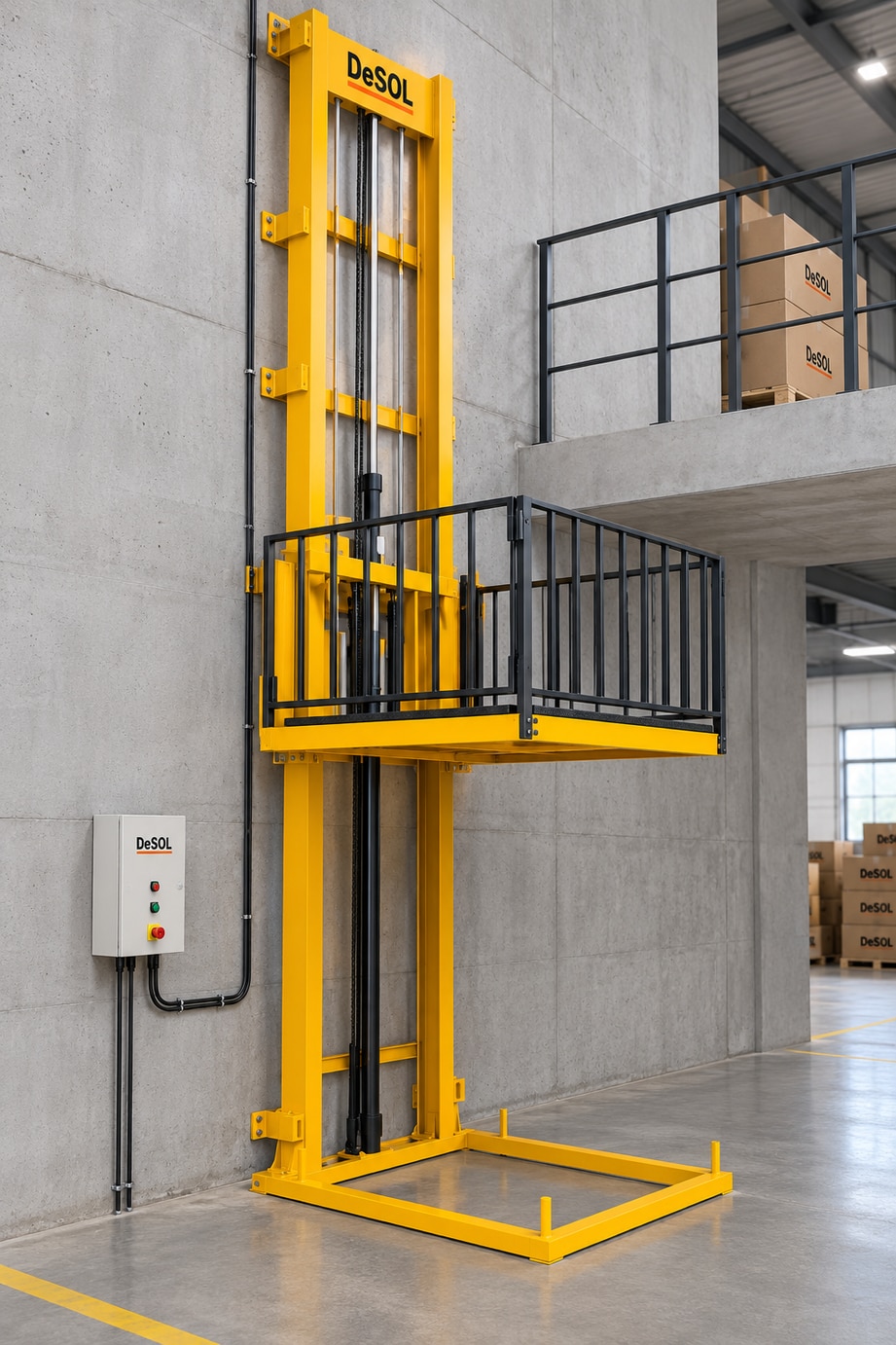 | Goods Lift / Material Handling Equipment DeSOL Single Mast Goods Lift is a compact and economical vertical lifting solution designed for safe and efficient movement of goods between... View product → |
Frequently asked questions
Which legal category and compliance evidence apply to a hydraulic goods lift?
Ask the manufacturer to identify whether the machine is a lifting table, service lift, industrial lift or machinery-integrated lifting device under the rules at your site. Request the applicable design and test records, risk assessment, user instructions, inspection schedule and copies of required licences or registrations, such as a Form 20B licence where applicable.
What capacity and geometry data must a hydraulic goods lift quotation state?
The quotation should state rated load in kilograms, platform length and width, clear door opening, travel height, number of stops, lifting and lowering speed, pit or overhead requirements, power supply, loading direction and duty cycle. It should also define whether the rating includes pallets, cages, trolleys and operators.
How do you check whether a hydraulic goods lift will fit the building and traffic route?
Measure the shaft or enclosure, pit, headroom, door thresholds, structural fixing points and access for installation. Map the route from receiving area to each landing, including pallet-turning space, aisle width, floor loading, fire doors and the handling equipment that will enter the lift.
Which safeguards and hydraulic failure controls should you demand?
Specify interlocked landing gates, a fully enclosed platform where required, emergency-stop controls, overload protection, hose-burst or pipe-rupture protection, non-return valves, mechanical supports or safety locks, and controlled emergency lowering. Confirm how the lift stops after power loss and how trapped loads or people are released.
How should you test and compare hydraulic goods lift manufacturers?
Compare like-for-like quotations that state equipment category, scope, exclusions, installation, commissioning, testing, warranty and preventive-maintenance intervals. Witness unloaded and rated-load tests, check landing accuracy and door interlocks, and obtain test certificates, maintenance instructions, spare-parts details and response commitments before acceptance.