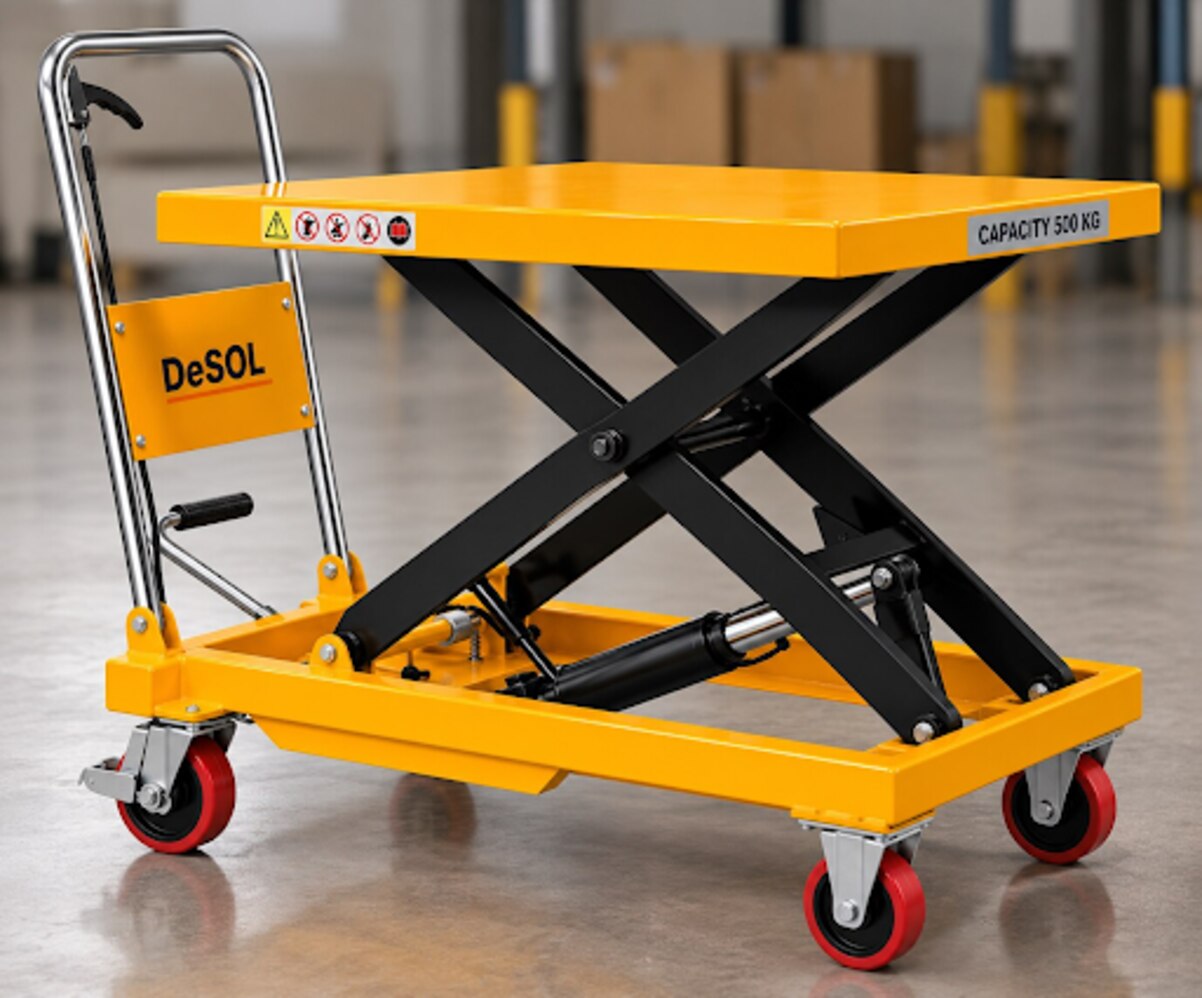
A load can be at the right elevation and still be uncomfortable to handle if the worker must reach across a pallet, twist around a trolley, or look down into a tall container. By the end, you will be able to match the working height, capacity, platform and mobility features to the task, then use the trolley without treating it as a substitute for a lift truck or personnel lift.
Key takeaways
- Set the platform near elbow height for precision work.
- Keep forceful tasks below elbow height to reduce awkward reaching.
- Compare capacity, platform size, lift method and adjustment effort.
- Raise, move, position and lower loads in that order.
Match the Working Height to the Task, Worker and Load
A comfortable working height lets you handle the load without shrugging, bending your back, or reaching beyond a stable ergonomic reach. Use elbow height as a starting point: precision work is usually near elbow height or slightly above, while forceful work belongs below it.
Operator stature and the task, not the trolley’s maximum height, set the target.
| Task | Comfortable working height | Lift-range implication |
|---|---|---|
| Precision assembly | At or slightly above elbow height | Set the maximum so the work surface meets the operator’s elbow zone |
| Forceful handling | Below elbow height | Prioritise a low enough setting for pushing, pressing or fitting |
| Inspection in a container | High enough to see and reach inside | Allow for the container’s load height, not just the platform |
| Transfer between stations | Near the receiving surface | Match the trolley range to both source and destination heights |
Measure the complete working zone before choosing a trolley. Record the lowest pickup height, highest placement height, operator stature, tool or fixture height, and load height.
A platform that reaches ideal elbow height while empty can put a tall tote above a comfortable reach; a short load on a trolley with a low maximum can still force bending.
Choose a range that covers the working surface or reachable load zone, rather than comparing platform heights alone. Keep the trolley close to the operator so the load transfers without extended horizontal reach or twisting around the platform.
Do not stand on a material trolley to gain height; personnel lifting requires equipment designed and guarded for that purpose.
Choose Tasks Where Repeated Height Adjustment Removes Strain
Choose it when the same load needs repeated height changes to match a person, machine or work surface. The trolley reduces floor-level bending and overhead reaching during transferring parts, feeding a machine, assembly height, or inspection staging.
| Task | Why a scissor trolley helps | Where it fails |
|---|---|---|
| Transferring parts | Raises bins between workstations | Manual lifting remains if parts must be lifted on and off |
| Feeding a machine | Aligns containers with the loading point | It cannot correct a long reach into the machine |
| Assembly height | Keeps components within the operator’s working zone | A tall tote can place the parts too high |
| Inspection staging | Presents goods at a consistent viewing height | It does not secure unstable or shifting loads |
Position the trolley close to the operator and receiving surface. A raised load still creates strain if you reach across a wide pallet, twist around the platform, or pull the item sideways.
It is a poor choice when the task repeatedly involves lifting a heavy item from the floor onto the trolley. Pair it with pallet positioning, a slide transfer surface, rollers or a hoist so the manual transfer stays within your assessed lifting limits.
For intermittent moderate loads, a manual hydraulic model avoids battery charging and electrical infrastructure. Its slower cycling and greater pumping effort make it unsuitable for frequent lifts near rated capacity.
Never stand on the platform or ride with the load; material positioning equipment is not a personnel lift.
Compare Capacity, Platform Size and Lifting Method Before Buying
A 500 kg rated load does not mean 500 kg in every position. Check the permitted load centre, maximum eccentric load and whether the rating assumes an evenly distributed load; a concentrated load near one edge creates far more stress than the same mass centred on the platform.
Compare the purchase options against the job, not the headline capacity:
| Check | What to verify | Better choice |
|---|---|---|
| Load | Rated load, load centre and eccentric load limits | Capacity above the heaviest real load, including containers and fixtures |
| Platform | Platform dimensions, overhang, pallet feet and caster clearance | A footprint that keeps the load fully supported |
| Height | Lowered height, minimum and maximum height, plus load height | The complete load zone reaches the operator without overreaching |
| Movement | Wheel material, diameter, brakes and steering arrangement | Swivelling braked wheels for tight aisles; fixed wheels for straight travel |
| Power | Lifting speed and effort across the working cycle | Foot-pumped hydraulic for occasional lifts; battery-powered for repeated adjustment |
Do not select a platform that reaches the right height empty but puts a tall tote above comfortable access. A slow foot-pumped hydraulic unit wastes time when operators repeat lifts all day, while battery-powered equipment adds charging, maintenance and electrical-system requirements.
Ask whether the trolley is rated for travel while raised. If not, lower the platform before moving. Desol Associated Engineers can help compare a scissor trolley with a double-scissor lift table when the required height exceeds a single-stage range.
Related product
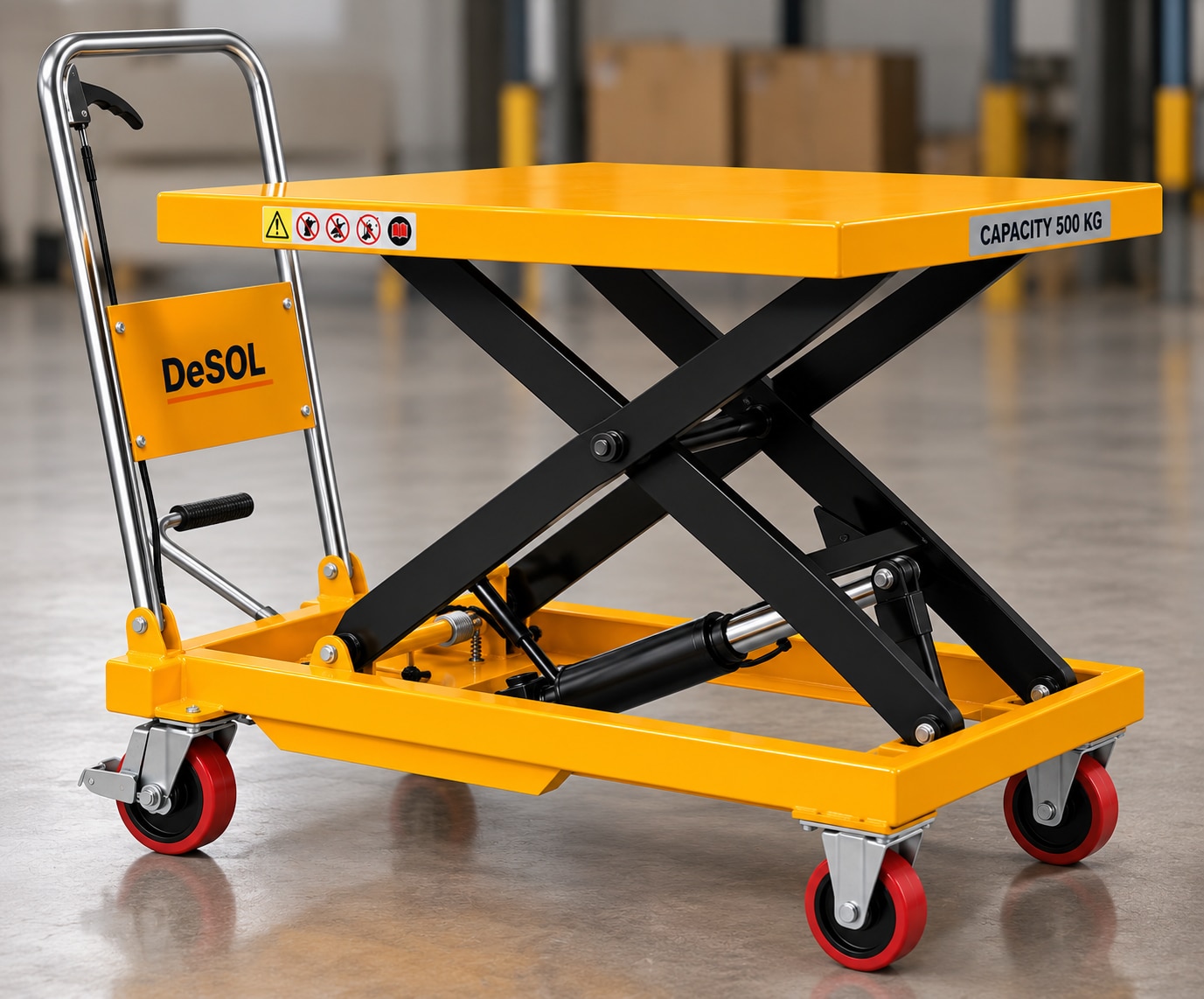 | Material Handling Equipment DeSOL Scissor Trolley is designed for efficient lifting, transporting, and positioning of materials in warehouses, production units, workshops and... View product → |
Check Stability Before Moving an Offset or Raised Load
Confirm stability at the load’s worst position, not with a centred test load. A load offset, overhanging load, or sideways push shifts the centre of gravity and increases the tipping moment on the scissor mechanism.
1. Check the manufacturer’s load chart for the permitted load-centre position, maximum eccentric load, platform height and any reduced capacity at maximum lift. Treat a concentrated load near an edge as unsafe until the chart confirms it.
2. Keep the entire load inside the platform footprint. Stop if pallet feet, forks, casters or projecting parts could roll or slide off the edge. Secure tall or loose items so a sideways push cannot shift them.
3. Immobilize the trolley before raising, lowering, loading or unloading. Apply the wheel brakes, but do not treat them as permission to work on a ramp, soft patch or uneven floor.
4. Inspect the route before moving. Confirm the stated floor gradient, then identify thresholds, dock plates, expansion joints and debris that could stop one wheel and tip the load. Check that the load does not block your view and that turning space allows a wide, slow turn.
5. Use raised travel only when the trolley is specifically rated for it. Otherwise lower the platform before movement and raise it at the positioning point; an elevated load raises the centre of gravity and makes turning or crossing uneven surfaces less stable.
If the load shifts, a wheel lifts, the brakes cannot hold, or the platform flexes, lower it and reposition or reduce the load.
Use a Raise, Move, Position and Lower Sequence
Use the same order every time: inspect, load, raise, move, position, then lower. A fixed sequence prevents a hydraulic fault from becoming a falling load and stops rolling or trapped hands from being treated as routine.
1. Complete a pre-use inspection. Check the platform, welds, wheels, brakes, hydraulic hose, pump, control and lowering valve for damage or leaks. Confirm the load is within the rated capacity, then place the trolley on a stable surface and apply the brakes.
2. Load at the lowest platform height. Centre the material, keep it within the platform perimeter, and secure anything that can roll or slide. Keep hands and feet clear of the platform, rollers, base and scissor mechanism; never treat a material trolley as a personnel lift.
3. Raise with the brakes applied and at controlled speed. Stand beside the trolley, not over the moving mechanism, and stop if the load shifts, the platform tilts, or the hydraulic system leaks. Do not reach beneath a raised platform.
4. Move only after lowering the platform, unless the manufacturer specifically rates the trolley for travel at that height. Release the brakes, keep the route clear, push at walking pace, and avoid ramps, thresholds, uneven floors and sharp turns. Raised travel increases the centre of gravity.
5. Reapply the brakes before raising for final alignment. Keep bystanders clear while you position the load; do not push it sideways from an elevated platform.
6. Lower under control until the load is fully supported. Watch for unintended descent, keep hands and feet clear, and remove the load only after the platform stops. Never work beneath it without the specified mechanical support.
Frequently asked questions
How do you choose a comfortable working height?
Use elbow height as a starting point: place precision work near elbow height or slightly above, and forceful work below it.
Which tasks benefit most from repeated height adjustment?
Choose a scissor trolley when frequent height changes let you avoid repeated bending, shrugging and reaching beyond a stable ergonomic range.
What should you compare before buying a scissor trolley?
Compare rated capacity, platform dimensions, lifting method and how much time or effort each height adjustment requires.
How should you move an offset or raised load?
Check stability before moving, then follow a raise, move, position and lower sequence.