
A crane’s rated capacity tells you only the maximum load, not whether the design suits your duty cycle, building, controls or maintenance regime. By the end, you will have a practical way to compare manufacturers, request verifiable engineering documents and assign responsibility for testing, installation and long-term support.
Key takeaways
- Share lift frequency, load spectrum and duty cycle—not only rated capacity.
- Verify runway loads, building clearances and wheel loads before selecting equipment.
- Request drawings, material records, weld evidence and test certificates.
- Compare inspections, spare parts, response times and handover documents.
Define the Crane Duty Before You Compare Manufacturers
A 10-ton crane lifting near its limit throughout every shift needs a different design from a 10-ton crane making occasional light lifts. Give each industrial crane manufacturer the operating history, not just the maximum load, so the selection reflects fatigue, braking, motor heating and component life.
- Maximum lifted load, average load as a percentage of rated capacity, load spectrum, lifts per hour or shift, operating hours per day and required service life.
- Longitudinal and cross-travel distances, lift height, travel speeds, acceleration and braking frequency, and the number of starts per hour.
- Indoor or outdoor location, wind speed in service and storm parking, ambient temperature, corrosive dust, moisture, hazardous-area classification and available power supply.
- Hook type and below-the-hook equipment, including attachment weight, centre of gravity, load geometry, plate thickness, surface condition, temperature and proof-test requirements.
- Tandem-lift requirements. State whether two hoists must share a load, then require load measurement, synchronization tolerance, independent limits and a defined failure response.
Use the duty data to request a declared crane duty classification rather than accepting a capacity figure.
| FEM classification ISO classification | What it captures | What to request |
|---|---|---|
| FEM/ISO duty class | Load spectrum and utilisation | Declared class and design-life basis |
| Single-hoist duty | Repeated lifting and travel demand | Cycles, speeds, motor and brake ratings |
| Tandem lifting | Unequal load sharing and control risk | Synchronization and independent protection |
| Outdoor duty | Wind, corrosion and weather exposure | Wind design, storm parking and corrosion measures |
Check the Crane Against the Building and Runway
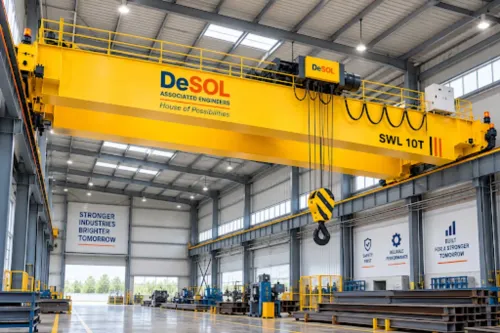
Do not approve a crane until its general arrangement (GA) drawing has been checked against measured building dimensions and a structural engineer has checked the resulting loads. A crane that fits the bay can still overload an existing runway, columns or foundations.
Require the quotation package to show:
- Runway gauge, span, bay length and end-truck dimensions
- Available headroom, roof clearance, trolley envelope and required hook approach at each end
- Maximum wheel loads, wheel spacing, lateral forces and end-truck loads
- Maximum and minimum runway reactions for loaded, unloaded, braking and skewing conditions
- Rail size, rail tolerances, runway alignment limits and conductor-bar clearances
- Column brackets, runway beams, anchorages and foundation loads needed for the installation
- Hoist drum diameter, rope reeving, upper-limit protection and maintenance clearances, not only the stated lifting height
- Installation access, removal routes and floor capacity for delivery equipment
Give these figures to the building’s structural designer, who must compare them with verified steel sizes, connection details, concrete strength and foundation records. Do not rely on a “10-tonne capacity” label; concentrated wheel loads can govern even when the lifted load is within rating.
Measure the existing runway rather than assuming the rails are parallel. Misalignment or incorrect gauge increases flange wear and wheel forces. Record acceptance limits for actual hook approaches, loaded travel and brake operation before installation, then require any mismatch to be corrected before handover.
Demand Traceable Engineering and Fabrication Evidence
A technically capable manufacturer can show how the quoted crane was designed, not merely name a standard. Request a standards matrix listing the edition and application of IS 3177, IS 807, IS 3938, EN 15011 and CMAA specifications, plus exclusions, equipment boundaries and the party responsible for each conformity document.
Before placing an order, require these controlled records:
- General arrangement drawing with span, headroom, hook approaches, wheel spacing and access clearances
- Design calculations covering girder strength, fatigue, stability, brakes, wheels, runway reactions and rated duty
- Electrical schematic identifying motors, brakes, contactors or VFDs, overloads, limits and control circuits
- Component schedule naming manufacturers, ratings, insulation classes, brake torque, gearbox ratios, rope construction and minimum drum and sheave diameters
- Material certificates linked to heat numbers, approved welding procedures, welder qualifications, weld inspection reports and dimensional inspection records
- Revision-controlled inspection, test and calibration records
A dual-hoist crane needs more than two rated hoists. The design must state load-sharing limits, synchronization tolerance, load measurement, independent limit protection and the response to a failed drive or brake.
For a VFD crane, demand defined behavior during power loss, emergency stop, overspeed, brake engagement, regenerative-energy control and voltage recovery. Ask how low-speed motor heating, braking-resistor capacity, harmonic distortion and electromagnetic compatibility were calculated. Generic “VFD included” wording proves none of this.
Make Safety, Testing and Handover Responsibilities Explicit
Put one responsibility matrix in the purchase order and require a named person to sign each deliverable. The manufacturer owns the crane’s design, safety-system selection and conformity evidence; the installer owns correct assembly, connection and site commissioning; the service contractor owns post-handover inspection and maintenance records.
- Manufacturer: supply overload protection, upper and lower limits, emergency-stop circuits, brakes, interlocks, alarms and control schematics. Provide the standards matrix, risk assessment, operating manual, maintenance schedule and factory acceptance test record.
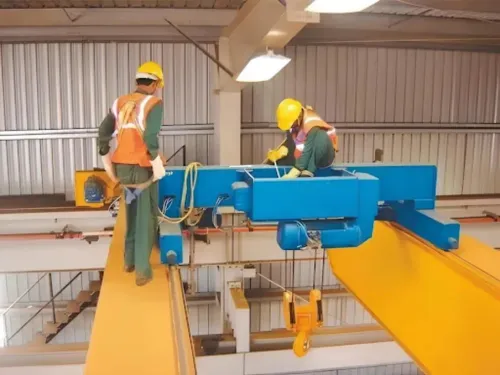
- Installer: verify runway alignment, clearances, power supply, earthing, travel limits, guards and radio or pendant operation. Record installation deviations, correct defects and provide measured results before energising the crane.
- Service contractor: define inspection intervals and acceptance limits for hooks, wire rope, sheaves, wheels, brakes, rails, electrical protection and structural members. Keep inspection histories and identify defects that require removal from service.
- Owner: provide safe access, production isolation, lifting personnel and an approved test plan. Assign who supplies test weights, temporary power and rectification within a specified number of days.
| Test | Manufacturer responsibility | Installer and owner responsibility |
|---|---|---|
| Factory acceptance test | Verify dimensions, unloaded travel, controls, interlocks, alarms and document completeness | Witness agreed tests and record open defects |
| Site acceptance test | Support loaded tests and resolve design or component failures | Verify runway compatibility, loaded operation, brake performance, limits, emergency stops, hook approaches and system integration |
Do not treat a statutory inspection as an installation warranty or operator check. Confirm who books the first statutory inspection, submits certificates to the local authority, and hands over the signed dossier. Desol Associated Engineers should be evaluated on whether those records arrive with the crane, not after a dispute.
Related products
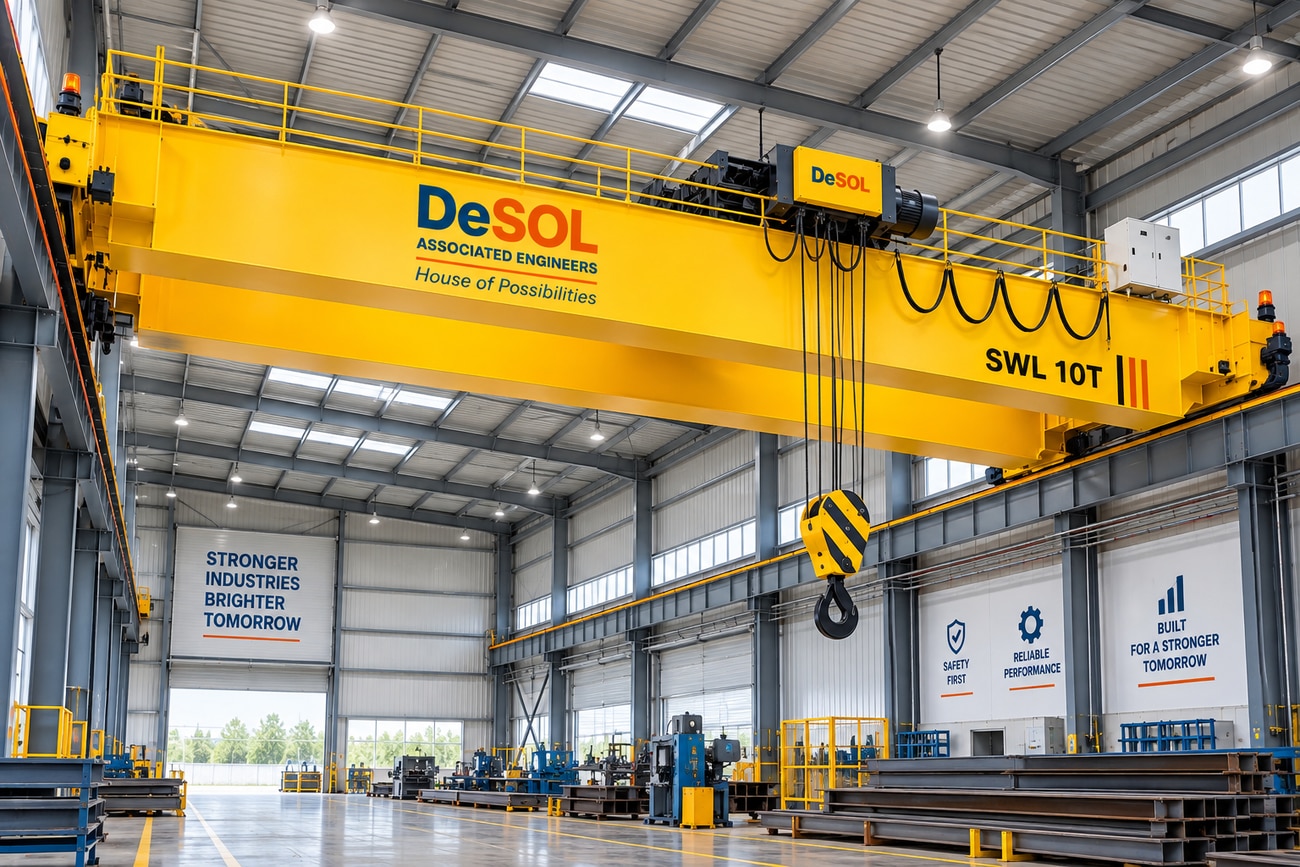 | EOT Crane / Overhead Crane / Industrial Lifting Equipment EOT Crane is a heavy-duty overhead material handling solution designed for lifting, lowering and horizontal movement of heavy loads across industrial... View product → |
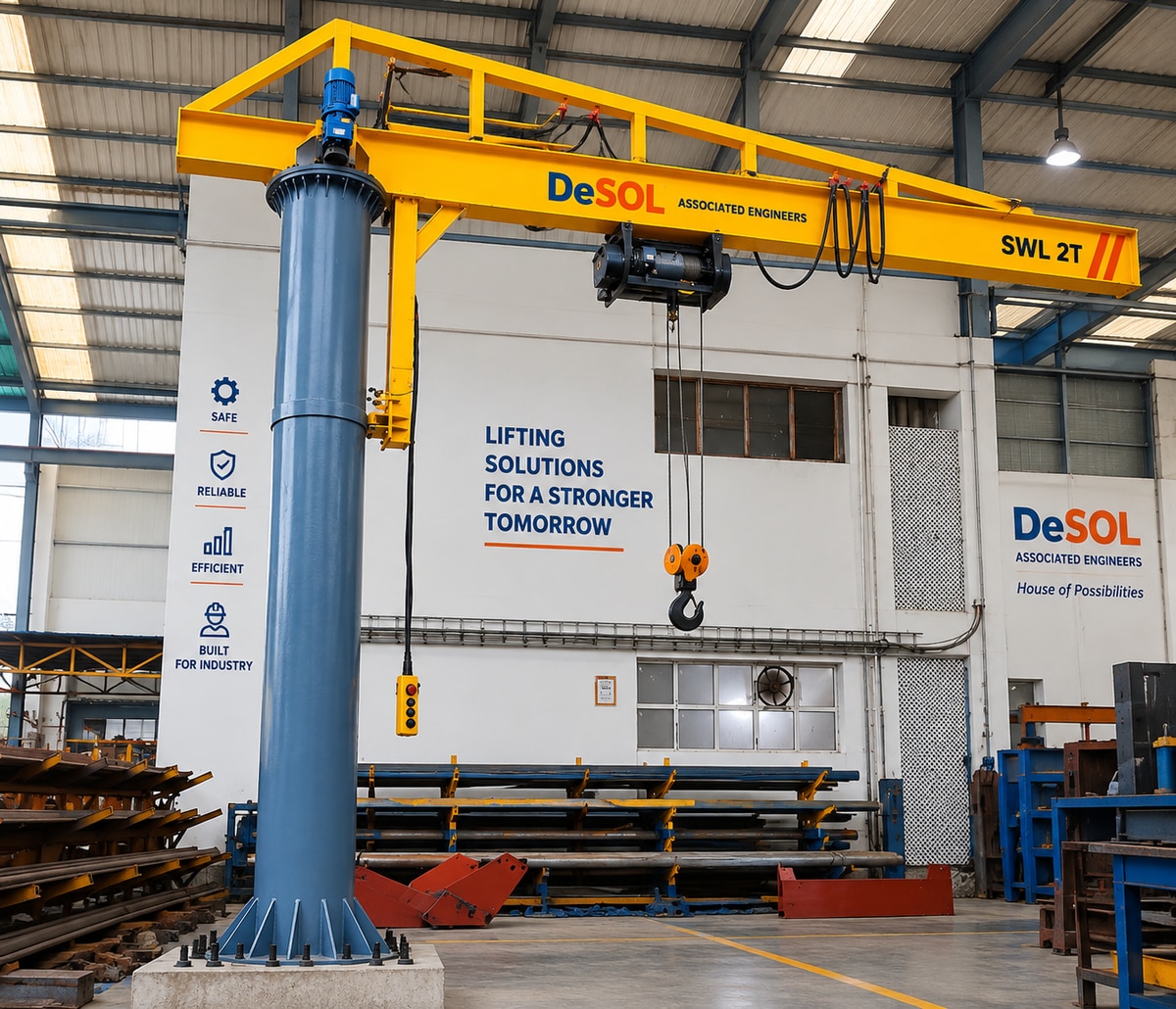 | Jib Crane / Pillar Mounted Crane / Material Handling Equipment Pillar Mounted Jib Crane is a heavy-duty material handling solution designed for efficient lifting and positioning of loads within a defined working... View product → |
Compare Lifecycle Support Instead of Purchase Price Alone
Compare total cost of ownership over the crane’s working life, not the invoice price. Ask each manufacturer to price scheduled maintenance, wear components, inspection labour, energy use, breakdown response and spare-part lead times over a defined period.
| Cost area | What to compare | Evidence to request |
|---|---|---|
| Wire rope life | Rope construction, drum and sheave diameters, groove profile, fleet angle, bending cycles and lubrication | Reeving drawing, rope specification and replacement interval |
| Controls | Contactors versus VFD crane controls, pendant or radio controls, fault diagnostics and replacement access | Electrical schematic, drive model and programming backup |
| Wear parts | Brakes, wheels, sheaves, ropes, festoon systems and electrical protection | Parts list, expected service life and prices |
| Support | Inspection intervals, acceptance limits, response time and technician coverage | Maintenance schedule, service terms and sample inspection record |
| Availability | Standard versus proprietary components and expected delivery during an outage | Stock list, lead-time statement and approved alternatives |
Require inspection criteria for hooks, wire rope, brakes, wheels, rails, electrical protection and structural members. Operator checks do not replace frequent and periodic inspections required under OSHA crane provisions.
Check whether the supplier provides:
- A five-year or ten-year maintenance and replacement estimate
- Parts identification using manufacturer and model numbers
- Training for lubrication, inspection and fault recovery
- A documented escalation route for breakdowns
A low-priced crane becomes expensive when a proprietary drive or control board stops production. Compare the promised wire rope life and parts availability against the cost of downtime, not against the quotation total alone.
Frequently asked questions
What operating information should you give an industrial crane manufacturer?
Provide rated load, lift frequency, average and peak loads, travel distances, operating hours, starts per hour, load spectrum and the required duty classification.
Why must the crane be checked against the building and runway?
The crane must suit runway span, rail alignment, wheel loads, end-truck clearances, headroom, building columns and the supporting structure—not just the lifting capacity.
What engineering and fabrication evidence should you request?
Ask for general arrangement drawings, load calculations, design details, material certificates, weld inspection records, component data and revision-controlled documentation.
How should you compare crane manufacturers beyond the purchase price?
Compare commissioning, load testing, operator training, inspection schedules, spare-parts availability, service response times, warranties and the completeness of handover documents.