A credible EOT crane quotation must prove more than lifting capacity and span. By the end, you will have a practical way to test the supplier’s engineering basis, manufacturing capability, site fit, compliance documents, installation plan and long-term service support.
Key takeaways
- Give suppliers load cycles, speeds, span, lift and design life—not only rated capacity.
- Verify the supplier’s engineering, manufacturing, testing and commissioning responsibilities.
- Compare every quotation line by line, including building interfaces and exclusions.
- Put inspection records, spare parts, response times and maintenance duties into the contract.
Start With the Design Basis, Not the Quoted Tonnage
Give the supplier a design basis, not just a safe working load. State the EOT crane’s load spectrum: starts per hour, average load, near-rated loads, operating hours, required design life, lifting speed, trolley and bridge travel speeds, span, lift, hook approach and expected pickup points.
1. Classify the crane from its actual workload. Require the supplier to state the EOT crane duty class and classification basis, such as ISO 4301, FEM classification, CMAA duty class or an equivalent Indian or national standard. Ask for a correspondence table when the quotation combines systems.
2. Demand the calculation behind the design life. “25 years” means little without total operating cycles, load spectrum, fatigue category and critical-component calculations for girders, end carriages, wheels, rails and hoist drums. Two cranes with the same capacity need different motors, brakes, wheels and fatigue design when one carries near-rated loads continuously.
3. Submit measured site information: runway length, rail size and alignment, column spacing, headroom, roof and runway clearances, power supply, ambient temperature, humidity, dust, corrosive exposure and floor access. Include required hook approach at both ends and the actual lifting envelope.
The supplier must verify runway capacity, rail gauge, elevation, straightness, end-stop loads, building reactions and maximum wheel loads. A crane can lift its rated load yet fail as a usable installation if rails are misaligned, clearances are inadequate or the structure cannot accept horizontal and wheel forces.
Test Whether the Supplier Actually Engineers and Manufactures the Crane
A real EOT crane manufacturer can explain its design decisions and show the records behind them. Ask who prepares the general-arrangement drawing and load chart, whether welding, machining, electrical-panel assembly, painting and load testing are completed through in-house manufacturing, and which work is subcontracted. For subcontracted work, identify who approves inspection records.
Request these documents before comparing prices:
- General-arrangement drawing and load chart
- Runway-reaction calculations, including maximum wheel loads and horizontal forces
- Motor data sheet and gearbox data sheet
- Electrical schematic, bill of materials and component make-and-model list
- Structural-fatigue calculations and the actual hook envelope
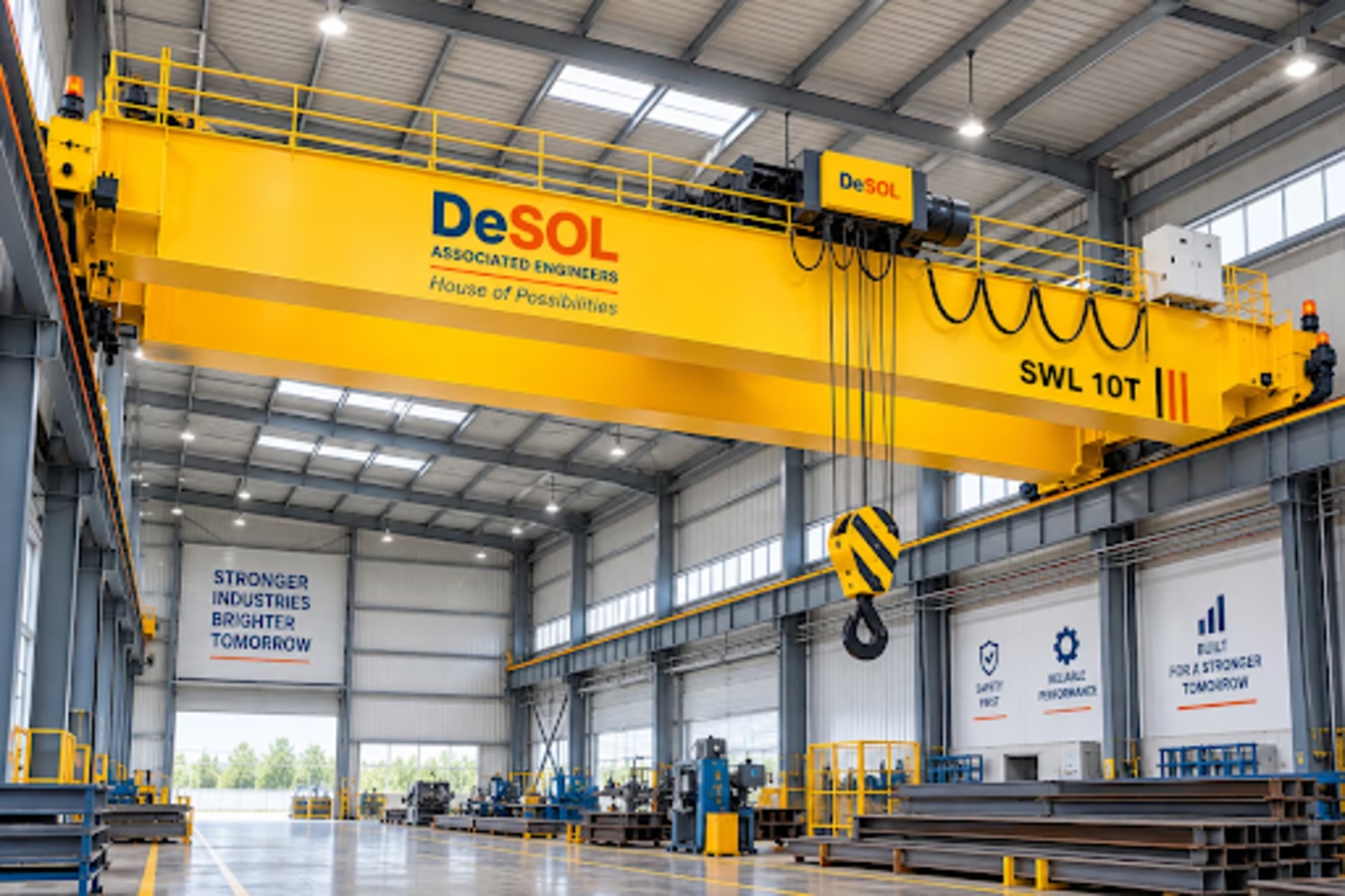
Check the drawing for girder arrangement, hoist type, drum or chain, brakes, wheels, end carriages, controls, limit switches, festoon or conductor-bar system, clearances and maintenance access. The hook envelope must show minimum end approaches, top and side clearances, obstructions and reach to each required pickup point.
| Question | Evidence from an EOT crane manufacturer versus trader | Why it matters |
|---|---|---|
| Who designed it? | Signed design review, calculations and marked-up drawings | Nominal span and capacity do not prove usable coverage |
| Who built it? | Welding, machining, panel assembly and paint records | Catalogue specifications do not verify workmanship |
| Who tested it? | Dimensional checks, weld procedure records and factory acceptance procedure | You can trace defects before installation |
A trader may provide an unverified catalogue sheet; a manufacturer can defend the design, explain subcontractor controls and demonstrate factory acceptance. Insist on runway-reaction calculations, fatigue assumptions and wheel-load limits before accepting either claim.
Compare Quotations Line by Line and Assign the Building Interface
Reject any EOT crane quotation that cannot be compared line by line. Use this EOT crane quotation comparison:
| Item | Confirm in the quotation |
|---|---|
| Capacity and duty | Safe working load, ISO 4301, FEM, CMAA or equivalent classification |
| Crane construction | Girder arrangement, hoist type, lifting and travel speeds |
| Controls | Control method, pendant or radio controls, control voltage |
| Protection | Brakes, limit switches and overload protection |
| Power collection | Festoon or conductor bars, make and rating |
| Runway | Runway rails and beams, gauge, rail size and end stops |
| Finish and delivery | Painting system, installation, commissioning, training |
| Commercial terms | Warranty period and exclusions |
Reject “standard accessories” unless the bill of materials gives each make, model and rating. Ask for the crane supplier’s maximum wheel loads, column reactions, rail gauge, elevation, straightness and end-stop loads; crane capacity does not prove building structural capacity.
The contract must assign runway beams, columns, end stops, civil work and structural strengthening to named parties. Require a clearance drawing showing hook approach at both ends, top and side clearance, the drum and hook-block envelope, sprinklers, lighting, maintenance access and every pickup and set-down point.
Prohibit routine side pulling. Dragging, stuck loads, snatch blocks or inclined pulls require a separately engineered arrangement approved by a qualified person, with its loads and controls stated before purchase.
Demand Evidence for Compliance, Testing and Safe Commissioning
Do not accept the crane on a verbal assurance that it was tested. Request a document pack tied to the serial number, drawing revision and installation location.
1. Ask for the applicable Indian Standards for EOT cranes, including IS 3177 and IS 807 where applicable, stated design calculations, factory inspection records, factory test records, third-party inspection reports and a test certificate. The calculations must identify design loads and assumptions; the certificate must identify the crane, test load, date, instruments and result.
2. Require separate procedures for the rated-load operational test and the proof test. The operational test must demonstrate hoisting, lowering, trolley travel, bridge travel, controls, brakes and limit functions at the specified speeds. It does not prove fatigue life, runway adequacy or production-duty performance.
A proof or overload test challenges structural and lifting capacity; it does not replace operating checks or emergency procedures.
3. Obtain signed records for normal stopping, emergency stopping, upper-limit protection and anti-two-block or hook-block protection where applicable. An upper-limit switch is protective equipment, not the operator’s normal stop. Include wheel and rail measurements, brake tests, rope or chain condition, emergency procedures and a signed commissioning record.
4. Confirm electrical suitability for temperature, condensation, dust, corrosion, control voltage, electromagnetic compatibility, variable-frequency drives, braking resistors and power-loss recovery. For a hazardous location, demand hazardous area certification matching the exact gas, vapor, dust or fiber classification and temperature class.
Finally, confirm the statutory inspection requirements for the installation location before putting the crane into service.
Make Maintenance, Records and Parts Support Contractual
An annual visit is not a complete inspection regime. Define frequent inspection intervals from daily to monthly, and periodic inspection intervals from one to twelve months, based on service, environment and component condition. A yearly attendance plan alone leaves gaps in preventive maintenance and compliance evidence.
Write the handover schedule into the contract. Require:
- The operation-and-maintenance manual, inspection checklists and signed acceptance records
- Brake and limit-switch test results, wire-rope or chain records, and wheel and rail measurements
- Lubrication schedules, fault history, electrical drawings and complete parts lists
- Software backups, drive-parameter backups, component make and model numbers, and approved substitutes
- EOT crane after-sales service terms covering local technician coverage, stocked wear parts and service response time
| Support item | Weak promise | Contractual requirement |
|---|---|---|
| Inspection | “Annual service included” | Named frequent and periodic intervals, checklists, findings and close-out dates |
| Breakdown response | “Prompt assistance” | Phone acknowledgement, technician arrival time and escalation route |
| Parts continuity | “Parts available” | Stocked wear parts and a redesign process for obsolete drives, pendant stations, radio receivers, encoders, brake coils and proprietary control boards |
| Warranty | “Standard warranty” | Written warranty exclusions and evidence required for rejection |
Compare warranty exclusions for misuse, overload, side pulling, power quality, corrosion and consumables. A regional engineering supplier such as Desol Associated Engineers earns consideration by documenting these obligations against your actual environment, not by merely delivering the crane.
Related product
 | EOT Crane / Overhead Crane / Industrial Lifting Equipment EOT Crane is a heavy-duty overhead material handling solution designed for lifting, lowering and horizontal movement of heavy loads across industrial... View product → |