The right choice depends on more than the height difference between a dock and a trailer. By checking traffic volume, vehicle variation, load forces, bay geometry, safety controls, and competing equipment types, you can decide whether powered hydraulic positioning justifies the installation and maintenance involved.
Key takeaways
- Choose hydraulic operation for frequent trailer changes and repeated forklift traffic.
- Check dock height, trailer variation, pit dimensions, and lip clearance before specifying.
- Match capacity to forklift weight, pallet loads, axle loads, and impact conditions.
- Use interlocks, vehicle restraints, dock lights, and a defined operating sequence.
Does Your Loading Pattern Justify Powered Hydraulic Operation?
A hydraulic dock leveler earns its place in a high-throughput loading bay when daily truck volume, multiple shifts, and forklift traffic volume make repeated manual repositioning costly. Powered deck and lip movement suits frequent trailer changes, heavy forklifts, heavy pallet weights, and operators who must reset the bridge several times per shift.
Use this decision test:
- Choose powered operation when trailer height variation is substantial, dock-use frequency is high, and the bay needs a permanently installed bridge.
- Choose another arrangement when loading is infrequent, the loading point moves around the yard, or no dock pit exists.
- Treat severe space limits or one consistent vehicle height as reasons to compare an edge-of-dock unit, mechanical leveler, fixed ramp, or another simpler design.
- Check the real forklift traffic volume and combined forklift-plus-load weight; powered movement does not make an under-rated bridge safe.
| Loading pattern | Best match | Why |
|---|---|---|
| Multiple shifts, changing trailer heights, heavy forklift traffic | Hydraulic dock leveler | Fast, repeatable deck repositioning at a fixed dock |
| Occasional loading at one predictable vehicle height | Mechanical or edge-of-dock leveler | Less equipment complexity when cycling is low |
| Ground-to-container or changing outdoor loading points | Portable container ramp or portable loading ramp | Moves with the work instead of forming a fixed dock connection |
A fixed dock connection transfers loads through a prepared pit and dock structure. A portable ramp bridges ground to a container or truck, but it is not a substitute for a permanently installed dock bridge where high-frequency dock traffic demands controlled, repeatable access.
Will the Bay and Vehicle Fleet Give the Leveler Enough Working Room?
The leveler fits only when its travel and lip geometry match the bay and every vehicle you intend to serve. A higher capacity rating will not fix a short lip, a recessed door, or a trailer that cannot approach squarely.
Record these dimensions before choosing the unit:
- Dock height measurement from the finished dock floor to the vehicle bed at both the highest and lowest expected positions.
- Dock leveler pit dimensions: pit length, width, depth, and any obstructions.
- Usable platform length and width after accounting for hinges, side frames, bumpers, and door hardware.
- Maximum truck-bed variation across the fleet.
- Approach clearance, trailer approach angle, dock bumper position, and rear-door clearance.
- The vertical and horizontal gap the lip must cover, plus the required supported contact on the trailer bed.
- Lip projection, including the effect of short trailers, recessed doors, and container configurations.
- Suspension movement and floor condition, including uneven, bent, or damaged vehicle floors.
Confirm which truck types and container configurations can approach, align, and remain restrained. A short trailer or recessed door can leave too little lip engagement; suspension compression can then unload the bridge during forklift travel. Exclude vehicles that cannot provide stable bed support.
If the travel range cannot cover the fleet, specify a longer lip, dock lift, vehicle lift, revised dock height, or a different bay layout. Do not compensate with a larger-rated leveler. That leaves the approach geometry, door clearance, turning space, or trailer contact unresolved.
How Do You Specify Capacity, Conditions, and Failure Protection?
Specify the dock leveler rated capacity from the worst load at the deck, not the forklift’s advertised gross capacity. Include the forklift, battery or fuel, heaviest pallet load, axle loads, pallet loads, concentrated wheel load, and impact from entering the leveler. Request the test and rating basis, then compare it with ANSI MH30.1.
| Rating basis | What it measures | Why it matters |
|---|---|---|
| Distributed | Load spread across the platform | A nominal rating can overstate performance under narrow wheels |
| Concentrated | Point or wheel loading | Exposes deck stress from small wheels and heavy axles |
| Static | Load at rest | Does not represent entry impact |
| Dynamic | Moving or impact loading | Tests the working condition that damages under-rated decks |
Write the operating conditions into the specification:
- State the cold-room temperature range and require hydraulic fluid viscosity and seals suited to it.
- Identify washdown, salt, fertilizer, food residue, and coastal exposure; specify corrosion-resistant deck and lip details, protected cylinders and hoses, suitable coatings, drainage, and a hydraulic power pack outside routinely flooded areas.
- Require a velocity fuse or equivalent flow control against uncontrolled descent, plus a mechanical maintenance support. Hydraulic pressure alone is never a work platform.
- Define power-loss behaviour, emergency lowering or manual return, safe vehicle release, and any standby power requirement.
Give technicians access to hoses, fittings, seals, cylinders, and leaks. Inspect hoses, seals, hinges, welds, deck deformation, controls, and safety supports; remove leaking equipment from service until repaired.
What Operating Sequence and Safety Controls Must the Bay Follow?
A hydraulic leveler never controls a moving trailer. Use this dock leveler operating procedure for every loading cycle:
- Position the vehicle squarely against the dock and engage the vehicle restraint, or complete the site’s approved positive anti-creep procedure. Do not rely on wheel chocks alone where the risk assessment demands more.
- Set the vehicle brakes and confirm that the interlocked traffic lights show the vehicle is secured and loading may begin.
- Raise the deck with the control station, then extend the lip onto the truck bed. The lip must rest on sufficient bed length and carry the intended load without hanging on the edge.
- Inspect the bridge, lip contact, controls, and dock gap before forklift entry. Keep people away from moving parts and maintain a safe bridge angle; do not enter if the lip is unsupported, the deck is damaged, or the vehicle has moved.
- After unloading, remove people and equipment, retract the lip, lower the deck to its parked position, and wait for the traffic signal that permits vehicle release.
Place the emergency stop where an operator can reach it from the approach and control position. Guard exposed hinges, cylinders, and pinch points; apply warning labels, edge protection, and fall protection wherever an open dock edge remains accessible.
Follow EN 1398 or OSHA 29 CFR 1910.26 where applicable. Record inspections, repairs, and hydraulic leaks. Lock the leveler with its mechanical maintenance support or maintenance lock before anyone works beneath it; never trust hydraulic pressure alone.
Which Alternative Fits Better When Hydraulic Is Not the Best Match?
A mechanical dock leveler comparison is the sensible starting point when cycling is low and hydraulic complexity is unnecessary. Use the table to match the bay’s construction and operating pattern, not just its rated capacity.
| Option | Installation and operation | Best fit and trade-off |
|---|---|---|
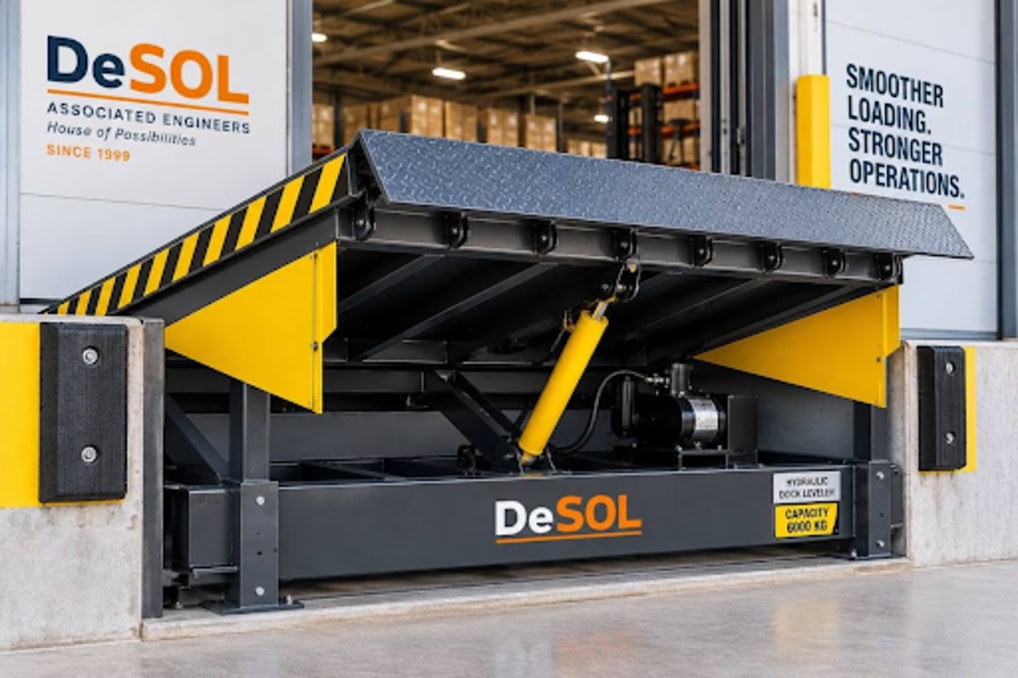
| Hydraulic | Full pit, accurate concrete work, drainage, power pack, motor, pump, valves, hoses and cylinders | Fast, powered positioning for frequent cycles and changing vehicle heights; higher maintenance and leak risk |
| Mechanical | Full pit and counterbalance mechanism, with no hydraulic power pack | Lower cycling with lower energy use and less hydraulic complexity; slower manual positioning |
| Air-powered dock leveler | Pit and compressed-air supply with controls and actuators | Sites with suitable existing air; avoids hydraulic-fluid leaks but adds air-system maintenance |
| Edge-of-dock leveler | Anchors to the dock face and avoids a full pit | Quicker concrete work and lower installation disruption; less travel and narrower vehicle-height compatibility |
| Portable container ramp | Movable steel ramp, no permanent pit or dock connection | Ground-to-container or ground-to-truck access; not a permanent dock bridge |
Before ordering, request:
- A bay drawing showing pit, bumpers, doors, approach clearance, drainage and service access
- Fleet bed heights, trailer types, container configurations and required lip travel
- Forklift, axle, wheel, pallet and dynamic load data
- Vehicle restraints, traffic controls and power-loss procedures
- Replacement-parts lists, inspection records and maintenance-support details
Do not solve an unusual height difference with a higher-rated leveler: specify a longer lip, dock lift, vehicle lift or revised layout instead. Desol Associated Engineers is useful when one review must coordinate the leveler, structure, ramps, restraints and handling equipment rather than quote capacity alone.
Related products
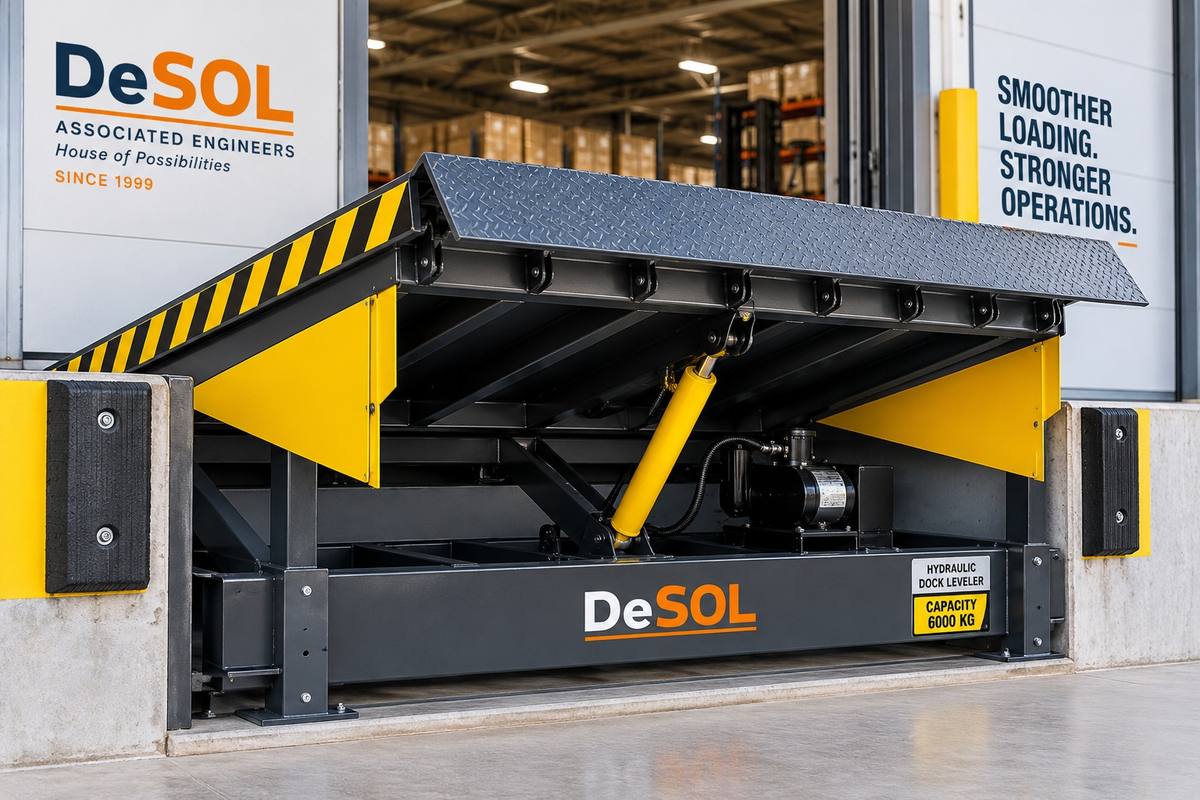 | A Hydraulic Dock Leveler is a high-performance loading dock solution designed to bridge the gap between a warehouse loading bay and a truck or... View product → |
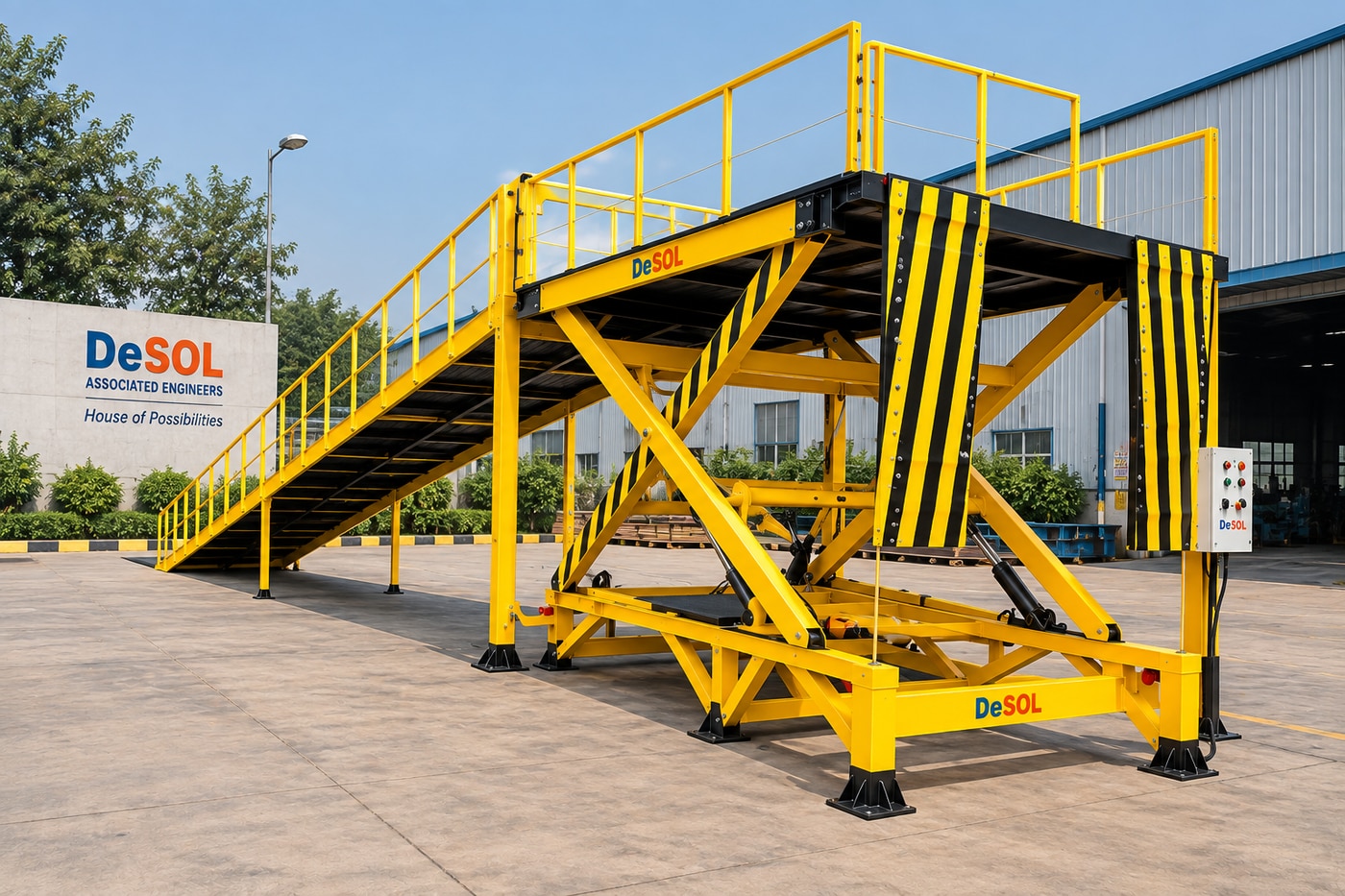 | Dock Leveler Stationary Hydraulic Dock Leveler by Desol Associated Engineers is a heavy-duty loading dock solution designed to bridge the height gap between warehouse platforms and trucks for... View product → |
Frequently asked questions
When does a hydraulic dock leveler justify its cost?
It suits high-throughput bays with frequent trailer changes, multiple shifts, heavy forklifts, and repeated deck or lip adjustments.
What bay and vehicle details must you check first?
Check dock height, pit dimensions, leveler travel, trailer-bed heights, vehicle mix, lip reach, and clearance around the loading bay.
How should you specify a hydraulic dock leveler?
State the rated capacity, forklift and pallet loads, impact conditions, operating range, environmental conditions, and protection against hydraulic or power failure.
What safety controls should a hydraulic loading bay use?
Use a documented operating sequence with vehicle restraints, dock lights, lip and deck controls, maintenance access, and procedures for power or hydraulic failure.
What alternatives fit when hydraulic operation is unsuitable?
Mechanical dock levelers suit lower traffic and simpler maintenance, while air-powered or edge-of-dock units fit bays with different space, capacity, or installation constraints.
Related product
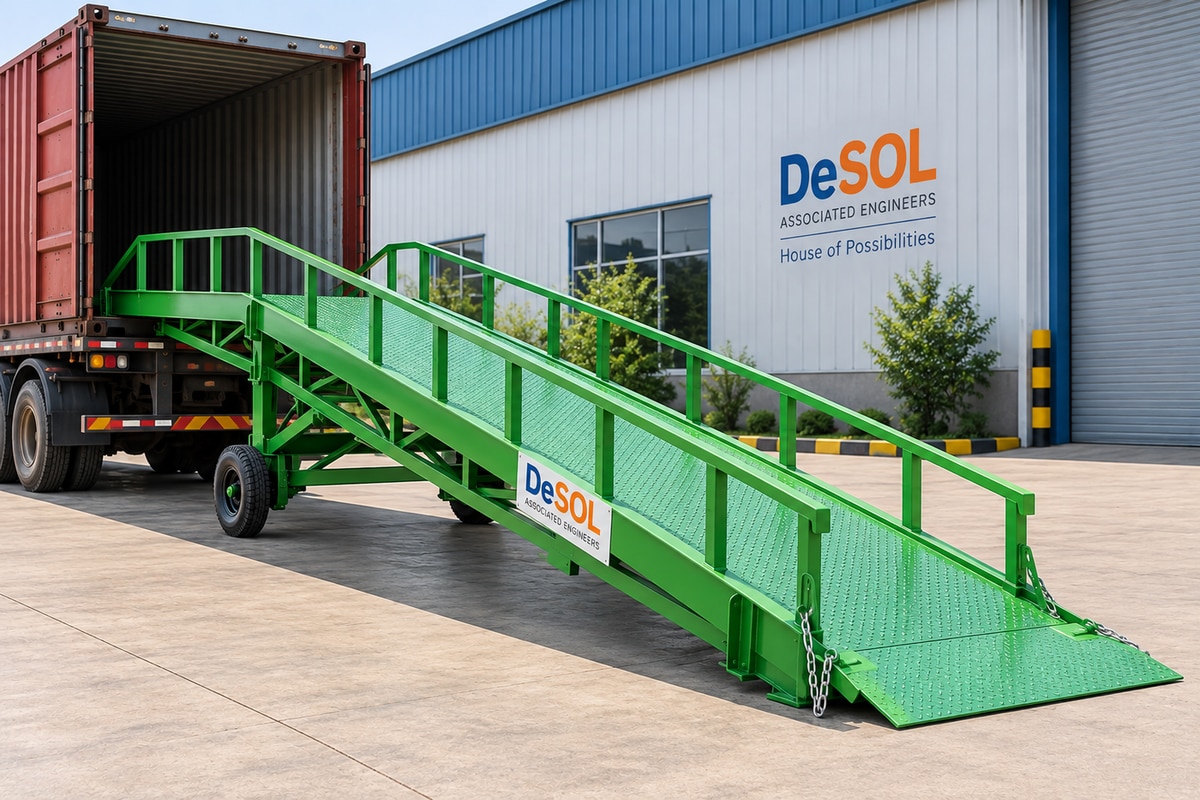 | Dock Leveler / Loading Bay Equipment Commercial Vehicle Dock Leveler DeSOL Commercial Vehicle Dock Leveler is a robust loading bay solution designed to bridge the height gap between the warehouse floor and commercial... View product → |