A crane quotation is only comparable when it defines the load spectrum, building interfaces, controls, testing and long-term support behind the rated capacity. By the end, you will have a practical way to qualify manufacturers, verify Indian compliance, compare total project scope and identify support gaps before placing an order.
Key takeaways
- State capacity, duty class and every below-the-hook attachment before requesting quotes.
- Ask for factory evidence, applicable standards and project references before awarding work.
- Compare installation, testing, controls, spares and training—not only the crane price.
- Put commissioning response times, warranty coverage and spare-parts commitments in writing.
Define the Crane Duty Before You Request Quotations
Give every bidder the same duty data, or a low quotation may simply reflect a lighter design. State the rated capacity and whether it includes the hook block, spreader, grab, magnet, lifting beam or other below-the-hook equipment; attachment weight counted as payload can overload the hoist.
1. Record the span, lifting height, usable hook travel, hook approach, headroom, runway arrangement and required positioning accuracy. Add lifting, cross-travel and long-travel speeds, acceleration and deceleration limits, control method, power supply and duty cycle.
2. Describe the actual load spectrum: percentage of lifts at each load band, average lifted load, lifts per hour, working hours per day, shifts per year, and expected working cycles over the crane’s life. Ask each manufacturer to state the proposed duty class under ISO 4301-1 and the corresponding CMAA classification.
Two cranes with a 10-ton rated capacity can need different hoists, brakes, motors and structures.
3. Specify indoor or outdoor exposure, ambient temperature range, dust, humidity, corrosive agents, wind, seismic conditions and temperature limits. Request a general-arrangement drawing, load calculations, motor and gearbox data, component makes, and wheel-load reactions for maximum and worst trolley positions.
4. Require a written factory acceptance test covering no-load and rated-load operation, brakes, limit switches, overload protection, emergency stops, alignment, controls, vibration where relevant, and power-loss recovery. Reject a comparison based on a demonstration load that does not represent your stated duty.
Test Whether You Are Buying From a Manufacturer or an Outsourced Supplier
A crane can meet the quoted safe working load and still be the wrong purchase if no single party owns the design. Ask the bidder to identify, by company name, who is responsible for each stage and to provide evidence for each handover.
- Engineering: obtain the general-arrangement drawing, load calculations, duty selection, wheel-load reactions and runway reactions from the party that seals or approves the design.
- Fabrication: identify the workshop performing girder fabrication, welding inspection, dimensional checks, surface preparation and painting; request its inspection records and welding procedure documents.
- Critical components: require a make-and-model schedule showing who made the hoist, brakes, motors, gearboxes, wheels, encoders, contactors, drives, limit switches and radio controls. Confirm who owns hoist and controls selection and who provides replacements after obsolescence.
- Testing: name the party conducting factory and site tests. The written factory acceptance test must cover no-load and rated-load operation, brakes, overload protection, emergency stops, limits, travel alignment and power restoration.
- Commissioning: require the commissioning engineer’s name, test sheets, operator training record and final sign-off authority.
Check that rated capacity excludes or includes the hook block, spreader, grab, magnet and lifting beam weight exactly as stated. Otherwise, attachment weight can consume payload capacity and overload the hoist.
Finally, demand an interface matrix covering power, PLC or SCADA, warehouse-management systems, networks, safety circuits and cybersecurity. It must show who supplies, integrates and supports every connection.
Verify the Site, Standards and Evidence Before Award
Do not accept a quotation until a documented site survey confirms the runway support, clearances, floor and foundation loads, headroom, access for erection, power quality, ambient temperature, dust, moisture, corrosive agents and hazardous-area classification.
Check integration with existing PLC or SCADA, warehouse-management and safety systems; require the I/O list, network protocols, cybersecurity boundary, control-panel heat load and short-circuit rating.
Ask for the following before award:
- A design compliance matrix naming the edition of IS 3177 for overhead travelling and gantry cranes, IS 807 for crane design, and CEA Safety Regulations 2023 for electrical safety provisions. “Compliant” alone is not evidence.
- A capacity statement showing whether the rated load includes the hook block, spreader, magnet, grab, lifting beam or other attachment. Attachment weight counted as payload can overload the hoist.
- Environmental selections for motors, brakes, festoon, controls and enclosures. IP rating alone does not approve hazardous, washdown, dusty, corrosive, cold-storage or high-temperature service.
- Statutory submissions and certificates required by the state authority: approved drawings, electrical-inspector documentation where applicable, competent-person examination and test certificate, commissioning or load-test certificate, and the lifting-equipment register entry.
| Evidence | Accept | Reject |
|---|---|---|
| Factory test record | Written no-load and rated-load results for brakes, limits, overload, emergency stops, alignment, controls and power restoration | Demonstration with an unrepresentative load |
| Outdoor coating record | Surface preparation, coating chemistry, thickness, galvanizing, drainage and touch-up procedure | “Painted” or “weatherproof” |
| Integration file | I/O list, protocols, ratings and responsibility boundaries | Verbal assurance that systems will connect |
Compare the Complete Delivered Scope, Not the Headline Crane Price
A fair comparison starts by putting every quotation inside the same delivered boundary. Ask each bidder to mark included, excluded, or provisional for runway beams, rails, festoon system, power cabling, civil work, freight, erection, taxes, commissioning, training and testing. Price every exclusion before selecting the lowest crane price.
| Scope item | What to reconcile | Evidence to request |
|---|---|---|
| Infrastructure | Runway beams, rails, conductor clearances and building reactions | Reaction drawings and civil-interface schedule |
| Controls | PLC/SCADA or warehouse-management links, I/O, protocols and cybersecurity | I/O list, network diagram and responsibility matrix |
| Installation | Freight, erection, alignment, power cabling and civil work | Method statement, lifting plan and exclusions |
| Testing | Factory and site tests, rated-load test and statutory documentation | Written FAT/SAT protocol and signed test records |
Also require the same technical boundary from every bidder:
- Confirm whether rated capacity includes the hook block, spreader, grab, magnet or lifting beam. If attachment weight is treated as payload, the hoist can overload despite a compliant nameplate.
- Obtain wheel-load reactions, end-carriage loads and runway-beam reactions for maximum and worst trolley positions, not just the safe working load.
- Compare control-panel short-circuit ratings, heat loads, emergency stops, brakes, limit switches and loss-of-power recovery.
- Require a representative FAT covering no-load and rated-load operation. A demonstration with a convenient test weight proves little.
- For outdoor cranes, compare surface preparation, coating thickness, chemistry, enclosure sealing, drainage and touch-up responsibility; “weatherproof” is not a service-life specification.
Judge Commissioning and After-Sales Support by Specific Commitments
A dependable manufacturer puts dates, deliverables and response times in the purchase order—not “service available after installation.” Make acceptance conditional on a factory acceptance test using a written protocol covering no-load and rated-load operation, limit switches, overload protection, emergency stops, brakes, travel alignment, control functions, relevant noise or vibration, and loss-and-restoration-of-power behaviour.
A demonstration with an unrepresentative test load proves little.
Require these commitments in writing:
- Commissioning: a named engineer, erection checks, a loaded site test, signed test records, a defect list and a close-out date.
- Operator training: scheduled sessions for operators and supervisors, practical operation, emergency procedures, daily checks, load limits and attendance records.
- Preventive maintenance: inspection intervals, lubrication points, access requirements, and wear limits for ropes, chains, hooks, sheaves, drums, wheels, rails, brakes, buffers and structural connections.
- Breakdown support: a phone response time, remote-diagnosis process, on-site attendance target and escalation contact.
- Parts continuity: critical spares in India, quoted lead times and an obsolescence plan for brakes, drives, contactors, encoders, radio controls, limit switches, wheels, bearings and pendants.
- Warranty: start date, duration, labour and travel coverage, consumables, misuse conditions and explicit warranty exclusions.
Ask Desol Associated Engineers, or any competing bidder, to identify who will meet each commitment and what document proves completion. Treat “low maintenance” and “lifetime support” as sales language until the intervals, costs and response times are measurable.
Related products
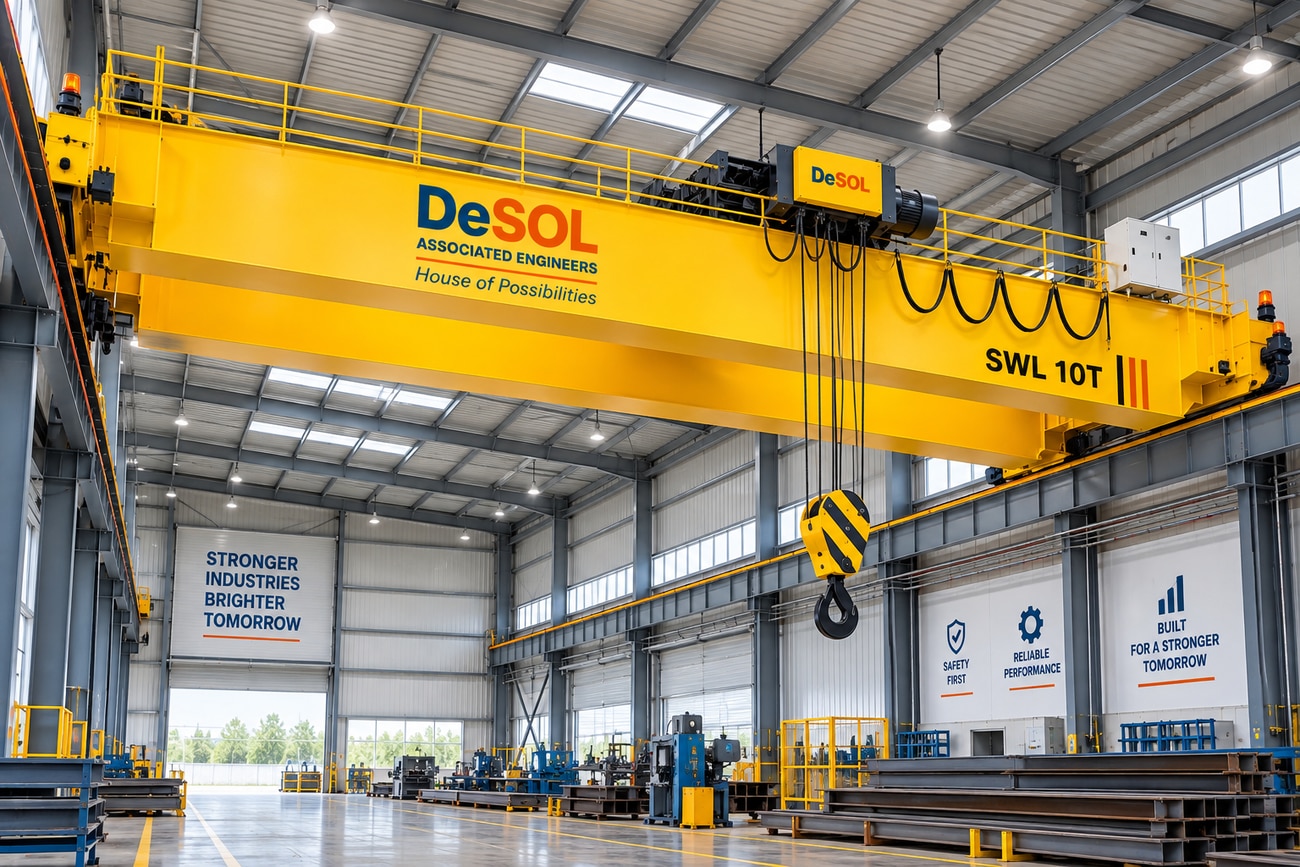 | EOT Crane / Overhead Crane / Industrial Lifting Equipment EOT Crane is a heavy-duty overhead material handling solution designed for lifting, lowering and horizontal movement of heavy loads across industrial... View product → |
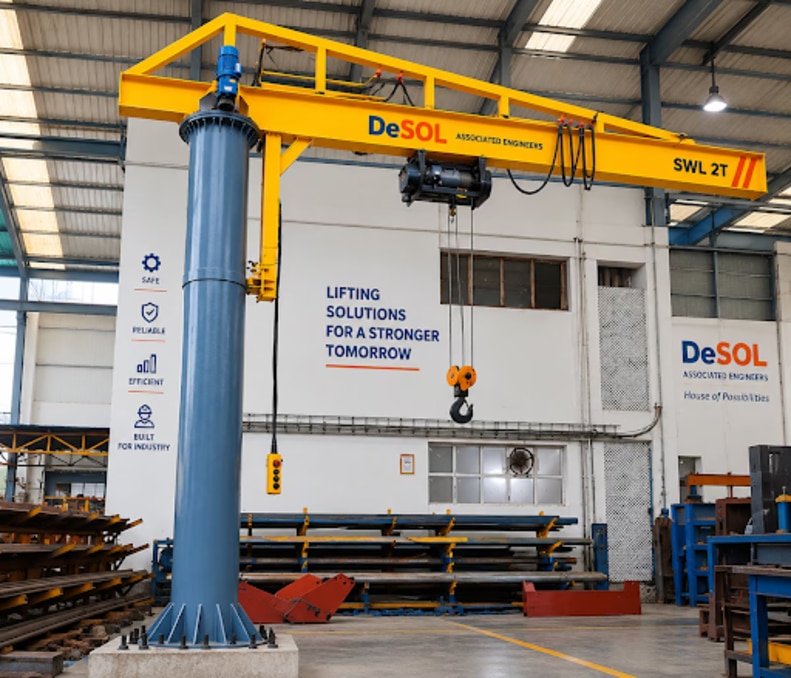
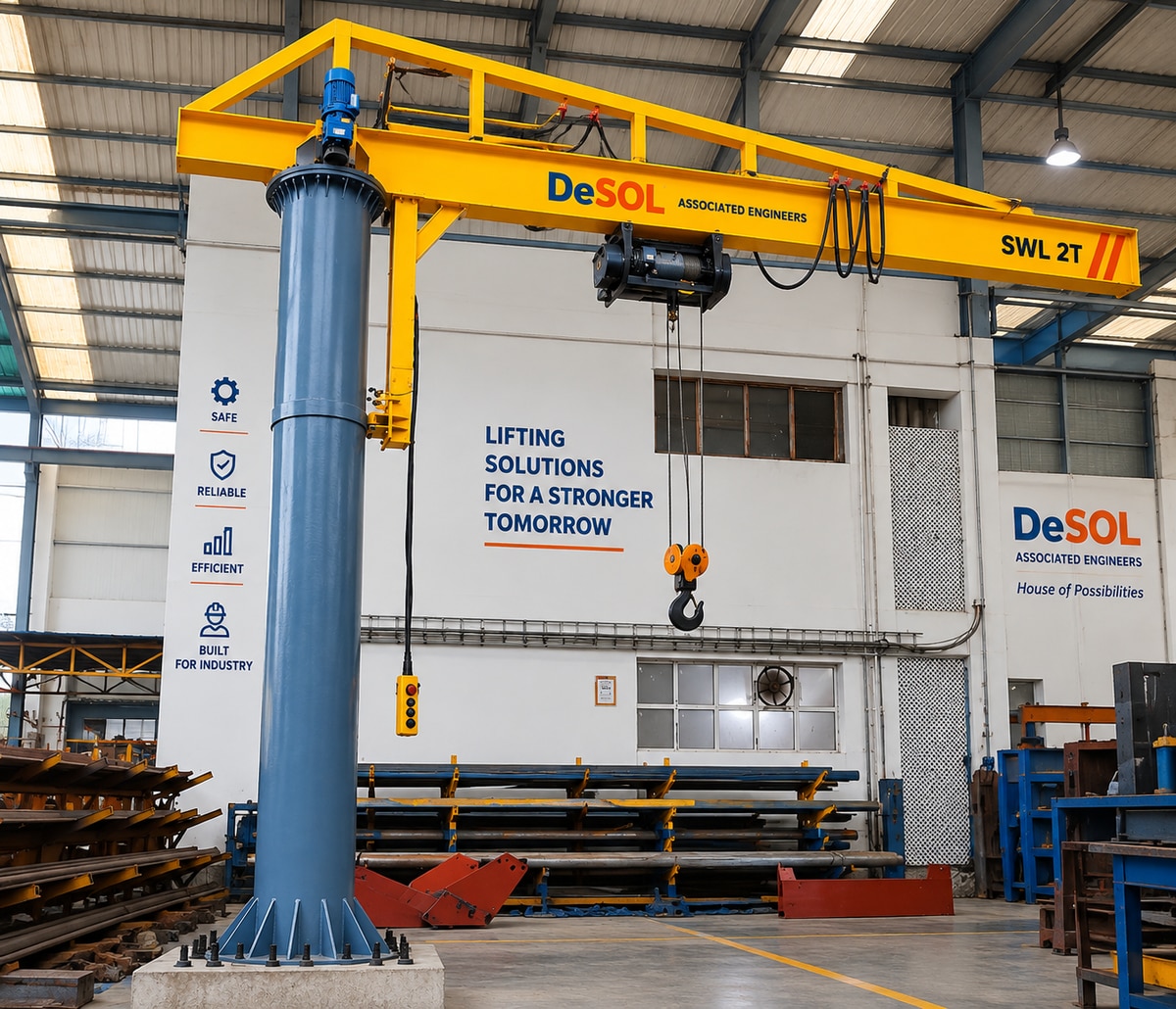 | Jib Crane / Pillar Mounted Crane / Material Handling Equipment Pillar Mounted Jib Crane is a heavy-duty material handling solution designed for efficient lifting and positioning of loads within a defined working... View product → |
Frequently asked questions
What duty information should you provide before requesting crane quotations?
Give every bidder the same rated capacity, lifting height, spans, travel distances, operating cycles, speed requirements and duty class. State whether the capacity includes the hook block, spreader, grab, magnet, lifting beam or other below-the-hook equipment.
How can you tell whether a crane supplier is a manufacturer or an outsourced supplier?
Request the manufacturing-site address, plant photographs or inspection access, fabrication and welding records, test procedures, equipment serialisation and evidence of completed projects. Ask which parts the supplier makes and which parts it sources.
What should you verify before awarding an industrial crane project?
Check the building survey, runway alignment, power supply, headroom, floor and column loads, access route, installation method and applicable standards. Request drawings, calculations, inspection records, certificates and named project references.
What should a complete crane quotation include?
Compare the delivered scope line by line, including the crane, runway equipment, electrification, controls, safety devices, installation, testing, painting, transport, taxes, operator training, documentation, spares and exclusions.
Which after-sales commitments should a crane manufacturer put in writing?
Require commissioning tests, handover documents, warranty duration and exclusions, response times, preventive-maintenance coverage, spare-parts availability, breakdown support and training responsibilities.