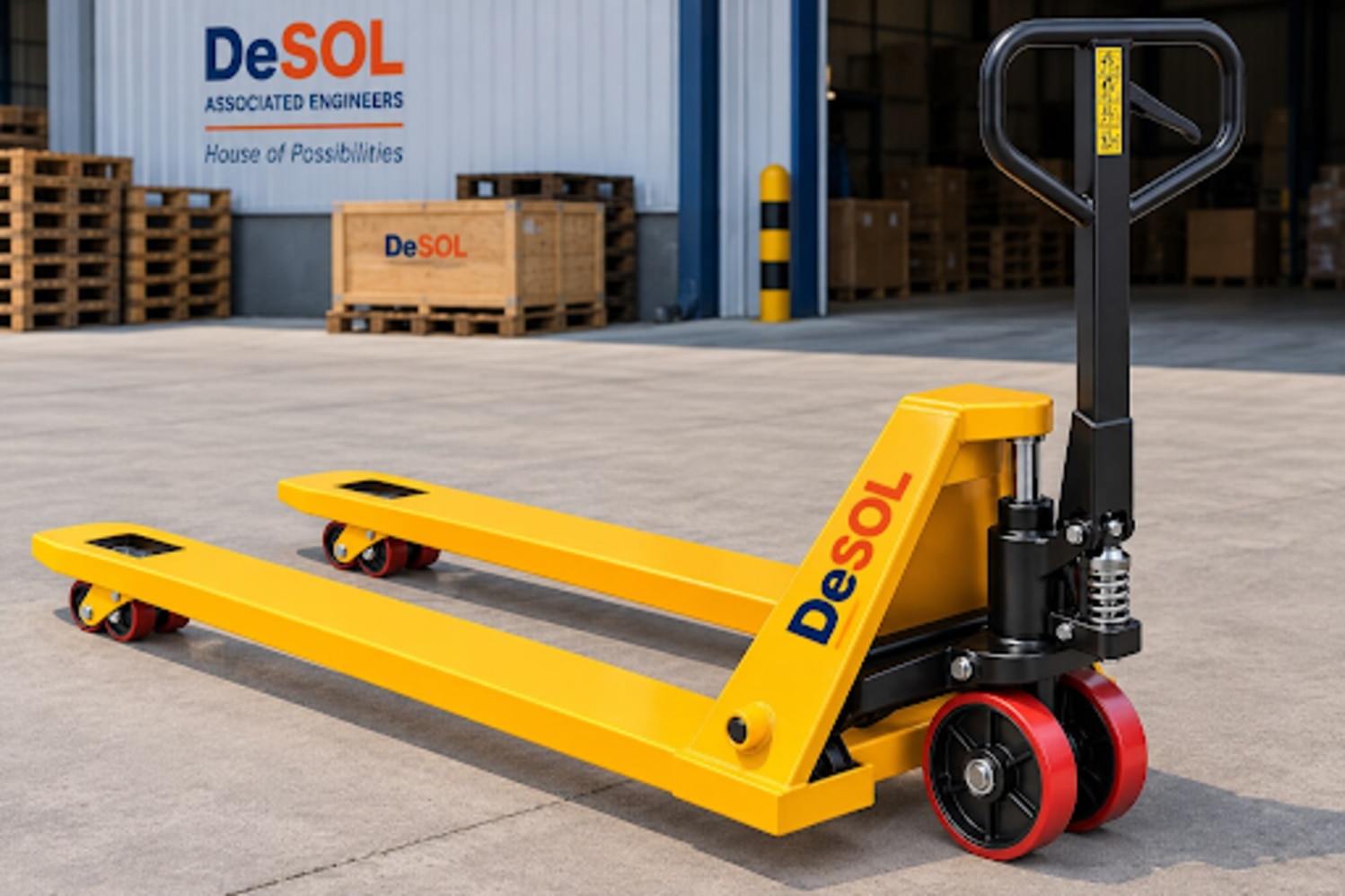
A pallet truck can have enough rated capacity and still fail your operation because the forks do not enter the pallet, the wheels lose traction on a dock plate, or the battery cannot last a shift. By the end, you will be able to compare suppliers using your pallet dimensions, load centre, travel pattern, floor conditions, safety requirements and total support cost.
Key takeaways
- Record load weight, dimensions, pallet type and centre of gravity before comparing trucks.
- Check fork dimensions, ground clearance and turning space against your warehouse layout.
- Match wheel materials and frame construction to floors, moisture, chemicals and temperature.
- Request inspection records, spare-parts details and measurable service response times.
Start With the Actual Load, Pallet and Capacity
A 2,500 kg headline does not prove the pallet truck capacity matches your operation. Start with the heaviest load: record its weight, dimensions, centre of gravity, pallet type and load height. Compare nominal capacity versus safe capacity, including stability during lifting, braking and turning.
- Ask for written confirmation against your actual pallet geometry, especially for tall, liquid-filled, unstable or uneven loads. An off-centre load shifts the load centre and reduces stability below the stated nominal capacity.
- Check pallet entry direction, closed-bottom pallets, damaged bottom boards and double-deep handling. A truck can carry the weight yet fail to enter fully or damage the pallet.
- If weighing matters, ask whether the integrated scale is legal for trade, its accuracy across your load range, calibration method and zero-drift limits. Without required commercial certification, treat it as a process tool, not a trade scale.
| Data-plate item | What to verify | Why it matters |
|---|---|---|
| Load centre | Stated distance from the fork face, compared with your load’s centre of gravity | A longer or shifted load centre lowers safe capacity |
| Fork dimensions | Fork length and width against pallet openings and bottom-board spacing | Incorrect dimensions prevent full entry or create unstable support |
| Lift height | Rated load at the required height, not only at minimum lift | Capacity can reduce as the load rises |
Confirm that the supplier’s rating assumes a standard load centre and that the loaded truck remains stable on your actual route. Ask for the complete data plate, not just “2,000 kg” or “2,500 kg.”
Compare Forks, Clearance and Manoeuvrability at the Site
Record pallet length, pallet width, fork-entry direction and bottom-board spacing before comparing fork length and outside fork width. Then measure the minimum fork height, maximum lift height, overall width, turning radius and ground clearance. A truck with adequate capacity still fails when forks are too short, too wide or too high to enter fully.
| Dimension | What to compare | Site consequence |
|---|---|---|
| Fork length and width | Match both to pallet openings and bottom boards | Short or wide forks damage pallets or leave the load unsupported |
| Overall width and turning radius | Compare with aisle width, rack-leg spacing and parked-pallet clearance | The truck cannot turn safely or align squarely |
| Minimum fork height and maximum lift height | Check pallet entry, dock plates and trailer thresholds | High forks strike boards; low clearance catches on transitions |
| Ground clearance | Measure ramps, joints, plates and thresholds | The chassis or load rollers bottom out |
Measure the narrowest aisle and tightest turn. Test fork-tip visibility and tiller-head reach in that aisle, not in an open demonstration area.
- Require loaded and unloaded gradeability figures stating maximum slope, surface condition, travel direction and stopping requirement.
- Treat a catalogue maximum grade as a limit, not a routine safe speed or operating slope, especially on a wet ramp or dock plate.
- Reject a hand pallet truck for high-rack storage, long travel routes, steep ramps or aisles with no safe turning room; specify a reach truck, stacker or tow tractor when the task requires it.
Match Wheels and Construction to the Floor and Environment
Floor and environmental conditions determine wheel material, diameter, ground clearance, sealing and corrosion protection. Inspect every route for concrete joints, potholes, thresholds, dock plates, ramps, standing water, oil, dust, metal swarf and abrasive debris before deciding warehouse floor suitability.
Wheel choice involves a trade-off:
| Wheel type | Strengths | Main risk or use |
|---|---|---|
| Polyurethane wheels | Quiet and protective on finished floors | Transmit shock across rough thresholds; suited to smooth indoor concrete |
| Nylon wheels | Roll easily under heavy loads and resist some chemicals | Hard, noisy and capable of marking vulnerable floors |
| Rubber wheels | Cushioning and traction on uneven surfaces | Higher rolling resistance and faster wear under heavy or abrasive loads |
Compare wheel diameter, load-roller arrangement and replacement cost, not just the material name. A larger wheel can cross joints and dock-plate edges more smoothly, while the wrong roller arrangement can increase catching and shock.
Ask the supplier to state the ground-clearance limit, permissible dock-plate transition, water and dust protection, and available corrosion-resistant or washdown construction. For ramps, require loaded and unloaded gradeability figures that name the maximum slope, surface condition, travel direction and stopping requirement; never treat a catalogue maximum as a routine limit on a wet ramp.
Cold rooms, wet processing, chemical exposure and outdoor work require confirmation of seals, lubricant, coating and battery performance at the actual temperature. Test the loaded truck on uneven floors, steep ramps and repeated thresholds before purchase.
Size the Technology for the Duty Cycle, Not the Brochure Rating
Choose by duty cycle: manual pumping is the wrong choice when frequent pumping, long loaded travel, repeated lifting or high throughput creates fatigue, delays or unsafe handling. Record pallets per shift, loaded and unloaded travel distance, starts per hour, ramp use, average load, shift pattern, operator changes and available charging time.
| Equipment | Best fit | Check before selection |
|---|---|---|
| Manual pallet truck versus electric | Short travel, low throughput and occasional movement | Operator effort, ramp traction and pumping frequency |
| High-lift pallet truck | Raised working position or occasional table-height handling | Required lift height, stability when raised and clearance beneath the load |
| Electric pallet truck | Sustained travel and lifting | Motor rating, brake temperature, battery autonomy and aisle controls |
For powered equipment, agree battery autonomy against pallets per shift or loaded kilometres. Reject an unqualified “operating hours” claim. Compare lead-acid and lithium-ion charging time, ventilation, opportunity-charging rules, battery handling and end-of-life arrangements.
- For lithium-ion, record the chemistry, battery-management protections, charger compatibility, replacement procedure, transport and storage requirements, and response to a damaged or overheated battery.
- Specify ramp performance for loaded and unloaded travel, stating maximum slope, surface, direction and stopping requirement. Do not treat a catalogue maximum grade as a routine limit on a wet dock plate.
- Test the controls in the real aisle: emergency reverse protection, automatic return-to-neutral, creep speed with the tiller raised, horn position, braking response, tiller-head reach and fork-tip visibility.
Sizing from maximum load alone can underspecify the motor, battery and brakes.
Demand Inspection Records, Parts and Measurable Service Support
A low purchase price means little without records that show how the truck was accepted and how failures will be handled. Use this pallet truck supplier checklist:
- Pre-delivery load-test record
- Completed inspection checklist
- Operating instructions
- Maintenance schedule with service intervals
- Defect-removal procedure identifying who can release a truck back into service
For powered trucks, require a documented pre-use examination. OSHA 1910.178 requires examination at least daily, or after each shift when trucks operate around the clock; an unsafe truck must be removed from service. Ask how the supplier documents defects, operator training before use and operator evaluation at least every three years in the United States.
| Service evidence | Ask for | Why it matters |
|---|---|---|
| Spare parts | Prices and lead times for hydraulic seals, wheels, load rollers, forks, brake components, handle assemblies, batteries, chargers and control boards | Long waits turn a minor fault into downtime |
| Repair response time | Maximum response time and escalation for an immobilised loading-area truck | “Nationwide service” is not measurable |
| Availability | Local safety-critical stock and loan-equipment terms | Keeps loading operations moving |
| Warranty | Battery coverage, exclusions and preventive-maintenance frequency | Prevents unexpected service bills |
Include wheel life, diagnostic-tool charges, imported battery costs and downtime in total cost of ownership. In a mixed fleet, compare charger connectors, fault-code access, PIN or key control, telematics and maintenance-system compatibility. Ask Desol Associated Engineers for the same written evidence rather than accepting a product description or service claim.
Related products
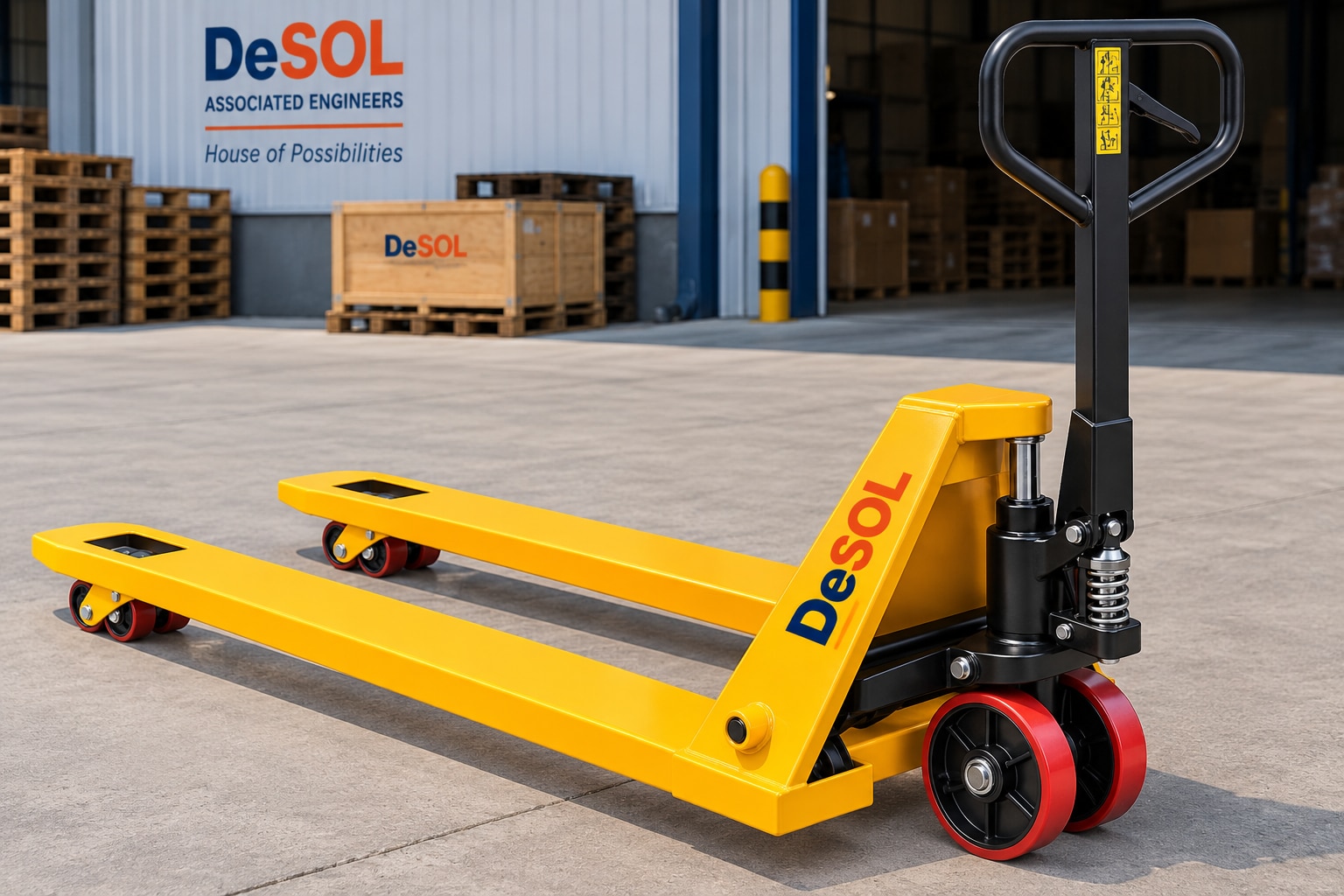 | Material Handling Equipment / Hand Pallet Truck ₹14500 Hand Pallet Truck (HPT) DeSOL Hand Pallet Trucks are robust and reliable material handling equipment designed for the safe and efficient movement of... View product → |
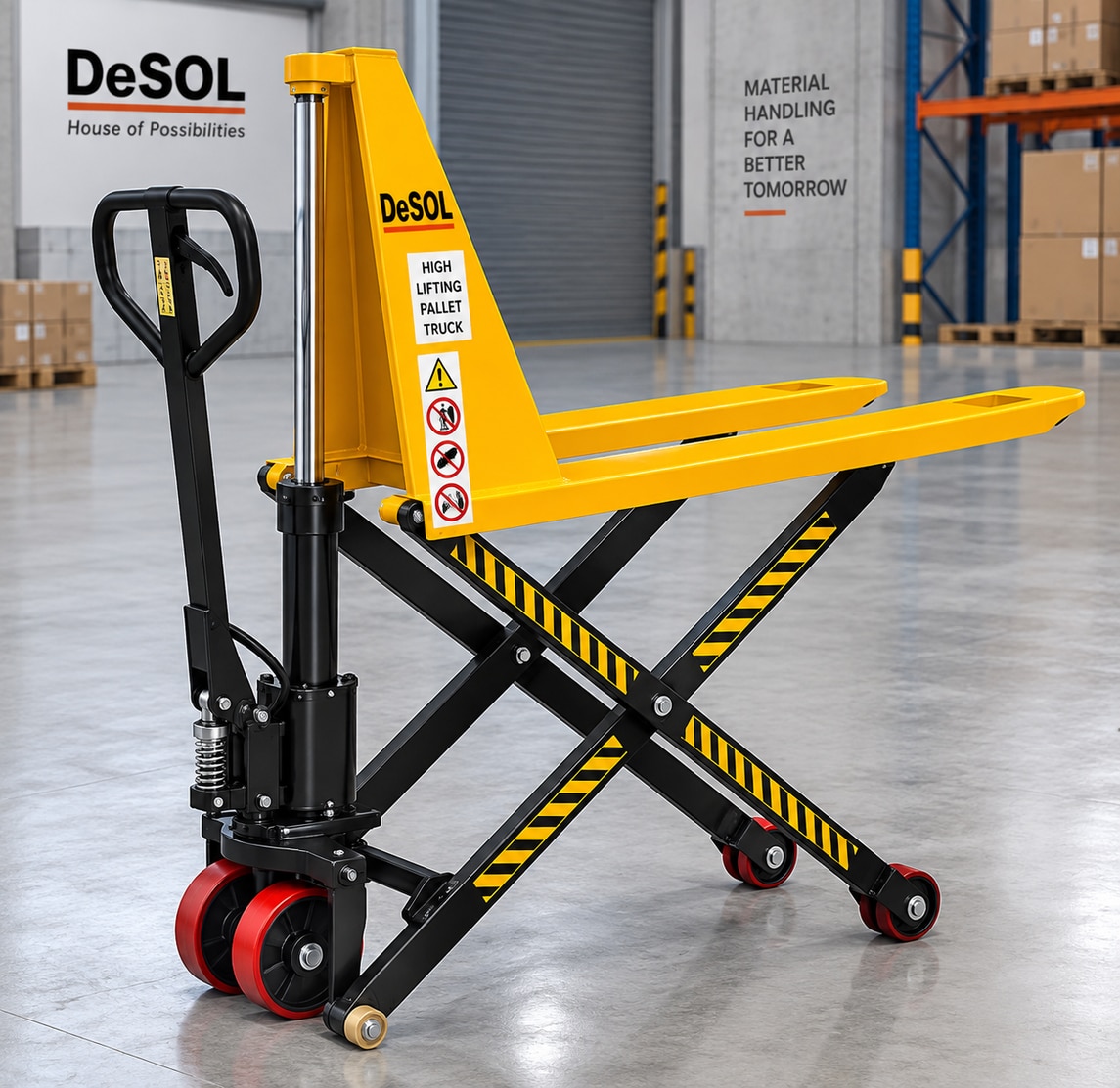 | High Lift Pallet Truck / Material Handling Equipment DeSOL High Lift Pallet Truck is a lightweight and easy-to-manoeuvre material handling solution designed for lifting and transporting pallets. View product → |
Frequently asked questions
How do you determine the right pallet truck capacity?
Record the heaviest load, its dimensions, pallet type, centre of gravity and load height. Compare nominal capacity with safe capacity during lifting, braking and turning.
Which pallet truck fork and clearance measurements matter?
Compare fork length, width, outside fork dimension, lowered height and ground clearance with your pallets, rack openings, dock plates and floor transitions.
How should wheels and construction match the warehouse environment?
Choose wheel materials and frame construction for the floor surface, moisture, chemicals, temperature, noise limits and debris found at your site.
Why should you size a pallet truck for duty cycle instead of brochure capacity?
Assess travel distance, loads per shift, lifting frequency, gradients and charging or maintenance time. A truck rated for the load can still be unsuitable for intensive work.
What service information should a pallet truck supplier provide?
Request inspection records, maintenance schedules, spare-parts availability, technician coverage and written response times for breakdowns and routine service.