
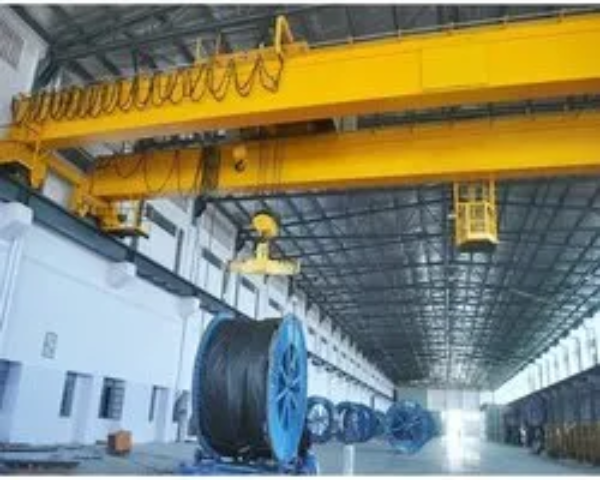
An EOT Crane is a significant part of material movement in many manufacturing facilities. Because quotations can differ in capacity, components, speeds, structural design, controls, duty classification, and included services, comparing suppliers purely on purchase price can give an incomplete picture.
For factories in Ghaziabad, Uttar Pradesh, a more structured evaluation can help procurement teams identify equipment that fits both present production requirements and long-term operating conditions.
Compare Crane Capacity Against Real Loads
The first specification is usually safe working load, but businesses should establish the maximum actual load before deciding capacity.
Selecting inadequate capacity creates obvious problems, while unnecessarily oversizing equipment can increase structural and capital requirements.
Consider typical loads as well as maximum loads and how frequently each will be handled.
Check Span and Hook Approach
Two cranes with the same rated capacity can provide different practical coverage.
Span, hook approach, lifting height, end clearances, and building dimensions affect how effectively the crane reaches pickup and placement positions.
Plant layouts should therefore be reviewed alongside the technical proposal.
Understand Duty Requirements
A crane performing occasional maintenance lifts should not automatically be specified the same way as equipment handling materials continuously across multiple shifts.
Operating hours, number of starts, average load, maximum load frequency, and production cycle influence the required duty.
Providing realistic usage information allows the system to be matched more accurately to operations.
Review Hoist and Travel Performance
Lifting, cross travel, and long travel speeds influence productivity and load control.
Higher speed is not automatically better. Some operations need rapid transfer across long bays, while precision assembly applications may benefit from more controlled positioning.
The right balance depends on the workflow.
Examine Controls and Safety Provisions
A technical comparison should identify what is included rather than assuming every quotation contains equivalent features.
Depending on the application, review:
- Limit switches
- Braking arrangements
- Emergency controls
- Electrical protection
- Pendant or remote operation
- Warning arrangements
- Overload protection where specified
- Access provisions for maintenance
Applicable standards and site safety requirements should also be considered during engineering.
Compare Support Beyond Installation
Downtime can be costly in production environments. Procurement managers should understand maintenance requirements, inspection support, component availability, documentation, and service response arrangements.
Desol Associated Engineers supplies industrial material handling and crane solutions for different manufacturing applications.
For Ghaziabad-based facilities, selecting an EOT Crane should involve a technical comparison of capacity, span, duty, speeds, controls, structural conditions, installation requirements, and ongoing maintenance needs.
A lower initial quotation does not necessarily represent lower operating cost, just as a higher-priced specification does not automatically make equipment more suitable. The stronger purchasing decision is the one supported by clear technical requirements and a realistic understanding of how the crane will be used throughout its working life.