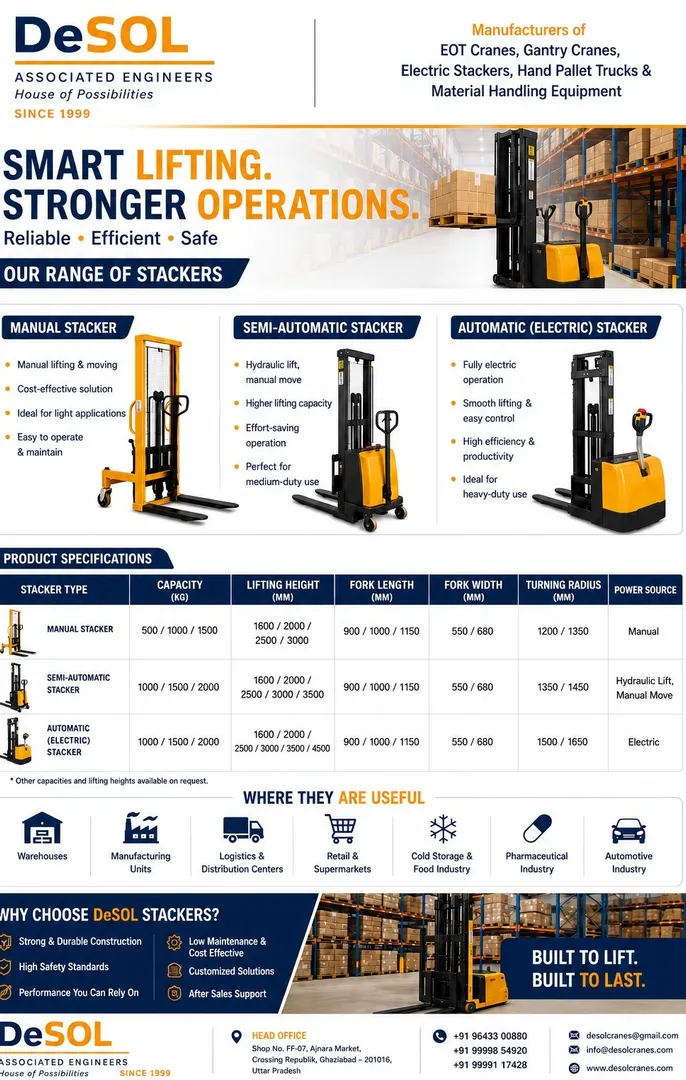
Many businesses initially choose manual stackers because of their lower upfront cost. However, as operations grow, the need for higher productivity and reduced operator effort often makes a semi electric stacker the better long-term investment.
FeatureSemi Electric StackerManual StackerLiftingElectric HydraulicManual HydraulicMovementManualManualProductivityHighModerateOperator FatigueLowHighMaintenanceLowVery LowInitial InvestmentMediumLowIdeal UsageDaily warehouse operationsLight-duty applicationsLift SpeedFastSlowSafetyBetter load controlDepends on operator effort
Which One Should You Choose?
Choose a Manual Stacker if:
- You handle pallets occasionally.
- Budget is your primary concern.
- Loads are relatively light.
Choose a Semi Electric Stacker if:
- You lift pallets frequently.
- Productivity is important.
- You want to reduce worker fatigue.
- You need faster warehouse operations.
Semi Electric Stacker vs Fully Electric Stacker
A fully electric stacker powers both lifting and travel, while a semi electric stacker powers only the lifting function.
FeatureSemi ElectricFully ElectricLiftElectricElectricTravelManualElectricBattery UsageLowerHigherPurchase CostModerateHigherMaintenanceLowerHigherBest ForSmall & medium warehousesHigh-volume warehousesProductivityHighVery High
Expert Recommendation
For warehouses handling 20–80 pallets per day, a semi electric stacker often offers an excellent balance between cost and performance. Facilities with very high throughput or long travel distances may benefit more from a fully electric model.
How to Choose the Right Semi Electric Stacker
Before purchasing, evaluate your operational requirements.
1. Load Capacity
Common capacities include:
- 500 kg
- 1000 kg
- 1500 kg
- 2000 kg
Select a model with sufficient capacity for your heaviest regular loads.
2. Lift Height
Typical lift heights:
- 1.6 m
- 2.0 m
- 2.5 m
- 3.0 m
- 3.5 m
The required height depends on your warehouse racking system.
3. Battery Capacity
A larger battery generally allows longer operating time between charges. Consider:
- Daily operating hours
- Number of lifting cycles
- Charging availability
4. Fork Dimensions
Ensure compatibility with your pallet type.
Common pallet standards include:
- Euro Pallet
- Industrial Pallet
- Custom Wooden Pallets
5. Floor Conditions
Semi electric stackers perform best on:
- Concrete floors
- Epoxy-coated warehouse floors
- Smooth industrial surfaces
Uneven or damaged flooring can affect safety and maneuverability.
6. Safety Features
Look for:
- Emergency stop switch
- Parking brake
- Overload protection
- Stable mast construction
- Durable forks
- Battery indicator
- Ergonomic controls
Technical Specifications (Typical)
SpecificationTypical RangeLoad Capacity500–2000 kgLift Height1600–3500 mmFork Length900–1150 mmBattery Voltage12V / 24VChargerBuilt-in or ExternalMast TypeDuplex / TriplexTurning RadiusCompact for warehouse use
Specifications vary by manufacturer and model.
Safety Guidelines
Safe operation protects both personnel and equipment.
Before Use
- Inspect forks for damage.
- Check battery charge.
- Verify hydraulic performance.
- Confirm wheel condition.
- Test brakes and controls.
During Operation
- Keep the load balanced.
- Never exceed rated capacity.
- Avoid sudden movements.
- Travel slowly in congested areas.
- Maintain clear visibility.
After Operation
- Lower forks completely.
- Switch off the equipment.
- Recharge the battery if needed.
- Store in a dry location.
- Report any faults immediately.
Maintenance Checklist
Routine maintenance helps extend equipment life and reduce downtime.
Daily
- Clean the machine.
- Inspect forks.
- Check battery level.
- Inspect wheels.
- Look for hydraulic leaks.
Weekly
- Tighten loose fasteners.
- Lubricate moving parts.
- Check mast alignment.
- Inspect safety decals.
Monthly
- Inspect hydraulic oil.
- Test battery performance.
- Examine electrical wiring.
- Check chain tension (where applicable).
Annual
- Full preventive maintenance.
- Hydraulic system inspection.
- Load testing.
- Battery health evaluation.
- Replacement of worn components if required.
Common Mistakes to Avoid
Many operational issues arise from avoidable mistakes.
❌ Overloading the stacker
❌ Using damaged pallets
❌ Ignoring battery maintenance
❌ Operating on steep slopes
❌ Improper operator training
❌ Poor warehouse housekeeping
❌ Skipping routine inspections
Cost Factors
The price of a semi electric stacker depends on several factors rather than a single fixed value.
Key factors include:
- Load capacity
- Lift height
- Mast type
- Battery quality
- Brand reputation
- Build quality
- Optional attachments
- Warranty
- Service support
- Spare parts availability
When comparing quotations, consider the total cost of ownership, including maintenance and after-sales service, rather than purchase price alone.
Who Should Buy a Semi Electric Stacker?
A semi electric stacker is suitable for:
- Manufacturing plants
- Automobile component manufacturers
- Warehouses
- Logistics companies
- FMCG businesses
- Pharmaceutical companies
- Food processing facilities
- Engineering industries
- Packaging units
- Retail distribution centers
Why Choose Desol Cranes?
At Desol Associated Engineers, we understand that every warehouse has unique material handling requirements.
We offer:
- Customized material handling solutions
- Reliable industrial equipment
- High-quality manufacturing
- Technical consultation
- Professional installation support
- After-sales service
- Preventive maintenance assistance
- Pan-India supply capabilities
Whether you need a single semi electric stacker or a complete warehouse material handling solution, our team can help you choose equipment that matches your operational needs and budget.
Keywords