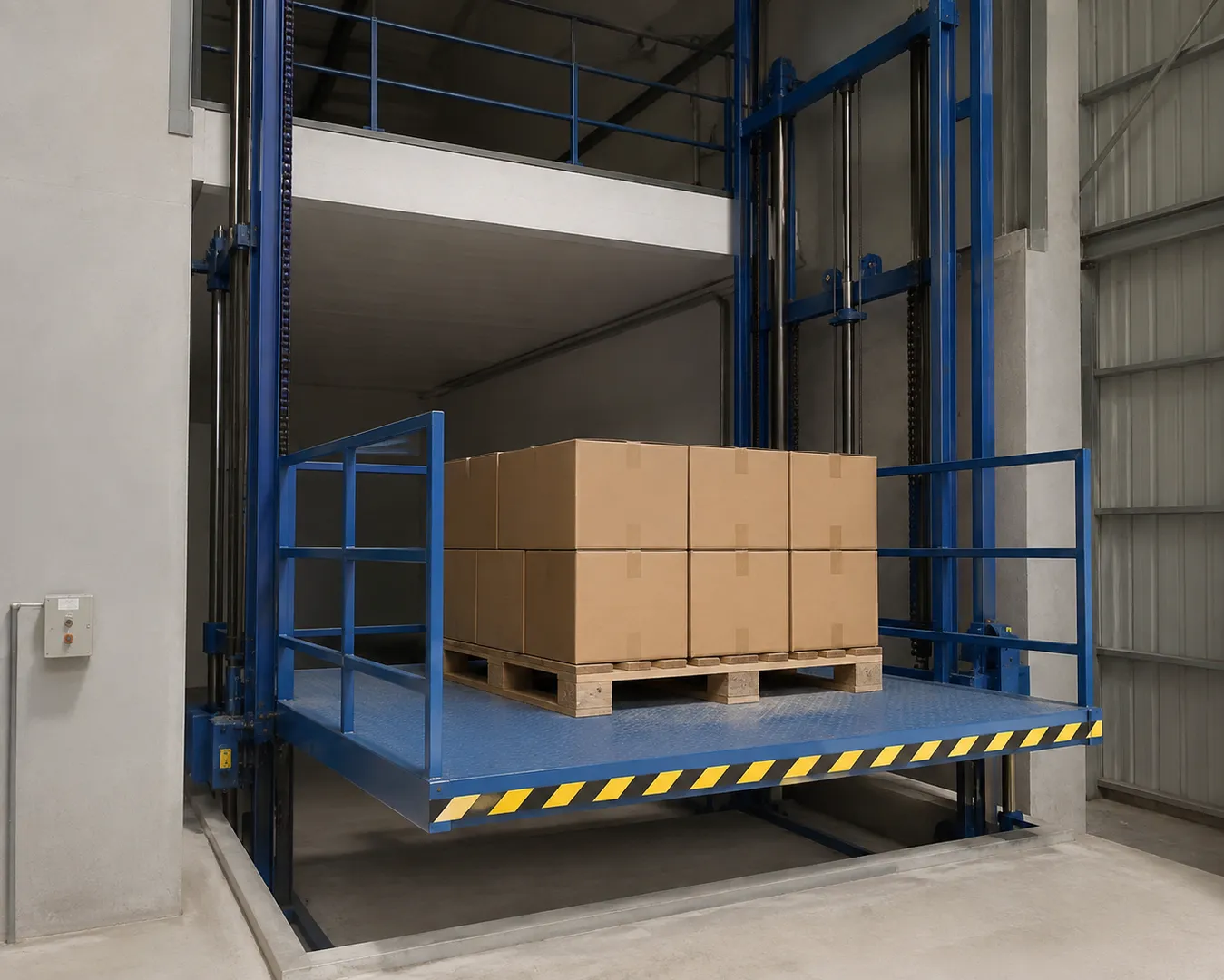
Moving heavy goods safely between different floor levels is a daily challenge in manufacturing plants, warehouses, logistics centres, and commercial buildings. Manual handling not only slows operations but also increases the risk of workplace injuries and product damage. This is why hydraulic goods lifts have become an essential part of modern industrial infrastructure.
Designed specifically for transporting heavy materials rather than passengers, hydraulic goods lifts improve operational efficiency while creating a safer working environment. For industries in Uttar Pradesh, these lifting systems are helping businesses streamline internal logistics and support higher production volumes.
What Is a Hydraulic Goods Lift?
A hydraulic goods lift uses hydraulic cylinders and a power unit to raise and lower heavy loads between different levels.
Unlike elevators intended for people, these lifts are built to transport:
- Raw materials
- Machinery
- Industrial equipment
- Finished products
- Storage pallets
- Heavy cartons
- Manufacturing components
Their sturdy construction makes them suitable for demanding industrial environments.
Improving Operational Efficiency
Efficient movement of materials is essential for maintaining uninterrupted production.
Hydraulic goods lifts help by:
- Reducing waiting time
- Speeding up internal logistics
- Improving workflow between departments
- Minimizing manual handling
- Supporting continuous production
Faster material movement translates into better overall productivity.
Enhancing Workplace Safety
Handling heavy materials manually can result in serious injuries.
Hydraulic goods lifts improve safety by reducing:
- Lifting-related strain
- Product drops
- Workplace accidents
- Unsafe manual transportation
- Material handling fatigue
Many systems also include safety features such as emergency stop buttons, overload protection, interlocking doors, and controlled descent mechanisms.
Suitable for Multiple Industries
Hydraulic goods lifts are widely used across various industries.
Common applications include:
- Manufacturing plants
- Warehouses
- Pharmaceutical facilities
- Food processing units
- Automobile workshops
- Printing industries
- Logistics centres
- Commercial storage buildings
Their flexibility makes them valuable across numerous industrial sectors.
Space-Efficient Design
Many facilities operate in buildings where space is limited.
Hydraulic lifts can often be installed with:
- Compact footprints
- Minimal machine room requirements
- Flexible platform sizes
- Custom lifting heights
This allows businesses to maximize available working space without extensive structural changes.
Handling Heavy Loads with Ease
Hydraulic lifting technology is particularly effective for transporting heavy materials.
Typical applications include:
- Industrial machinery
- Steel components
- Manufacturing tools
- Bulk inventory
- Heavy packaging
- Production equipment
Stable lifting reduces product damage while improving operational confidence.
Lower Maintenance Requirements
Compared with many mechanical lifting systems, hydraulic goods lifts generally have fewer moving parts.
Routine maintenance typically includes:
- Hydraulic oil inspection
- Cylinder checks
- Hose examination
- Safety device testing
- Electrical system inspection
Scheduled servicing extends equipment life while ensuring reliable operation.
Customization Options
Every industrial facility has unique operational requirements.
Hydraulic goods lifts can be customized based on:
- Load capacity
- Platform dimensions
- Lift height
- Number of stops
- Door configuration
- Operating controls
Tailored solutions provide better long-term performance than one-size-fits-all equipment.
Supporting Business Growth
As production increases, internal material movement also becomes more demanding.
Installing a hydraulic goods lift supports future expansion by:
- Increasing handling capacity
- Improving workflow
- Reducing labour dependency
- Supporting higher inventory volumes
- Enhancing operational efficiency
Industrial manufacturers often find that efficient vertical transportation quickly becomes an essential part of daily operations.
Companies such as Desol Associated Engineers design hydraulic lifting solutions based on customer-specific operational requirements. Many businesses evaluating industrial lifting systems use desolcranes.in as a resource to understand different equipment options and application suitability.
Building More Efficient Industrial Facilities
For manufacturers and warehouse operators throughout Uttar Pradesh, hydraulic goods lifts offer a practical solution for improving productivity, workplace safety, and material handling efficiency. By reducing manual effort, protecting valuable goods, and supporting smooth internal logistics, these systems play an increasingly important role in creating modern industrial facilities that are prepared for long-term growth.
Keywords